If you own an automatic swing gate in Sacramento, Placer, or Nevada County, choosing the right safety sensors is essential for protecting people, vehicles, and property. In Northern California—where driveways often see mixed vehicle and foot traffic, and weather swings from summer heat to winter rain—using the right combination of gate safety devices is key to preventing accidents and maintaining UL325-compliant operation.
Below is a clear breakdown of how swing gate safety sensors work, the pros and cons of each option, and what homeowners in the Sacramento region should consider when installing or upgrading a system.
How Swing Gate Safety Sensors Work
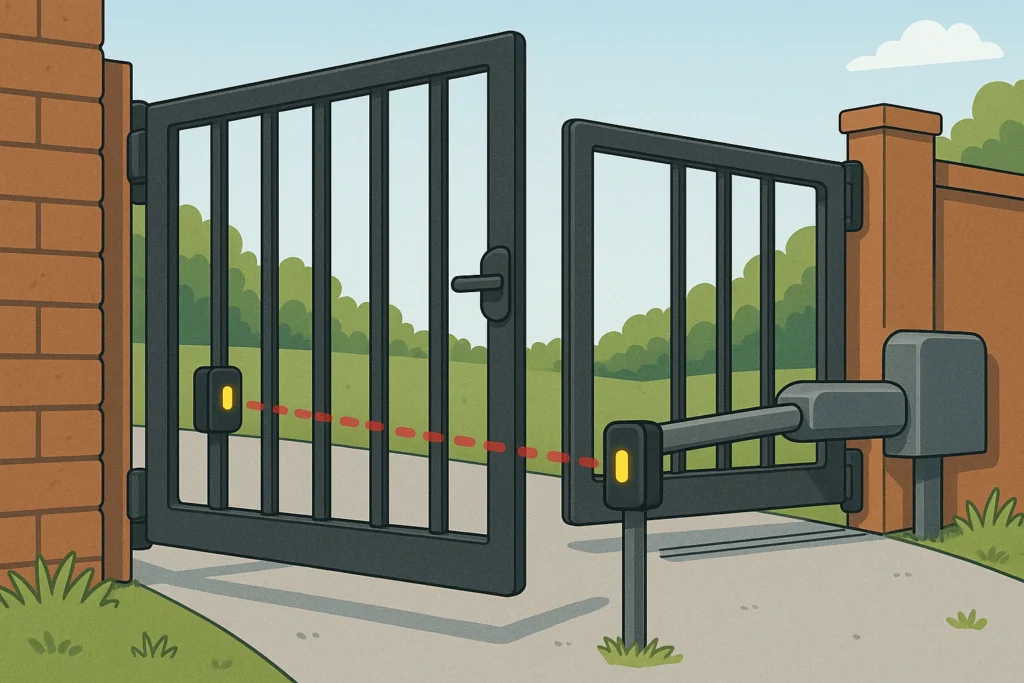
Automatic swing gates rely on sensors that detect obstacles before the gate moves into them. The two most common safety devices installed on residential systems in Sacramento are:
- Photo Eyes (Photoelectric Sensors)
These sensors send an invisible infrared beam across the gate’s swing path.
If something interrupts the beam, the gate immediately stops or reverses.
- Ground Loops (Vehicle Detection Loops)
These are wires installed beneath the driveway surface that detect metal objects—mostly vehicles—based on changes in magnetic fields.
They prevent the gate from opening or closing into a car.
Both technologies are widely compatible with LiftMaster, one of the most commonly installed gate brands in Sacramento and surrounding Northern California counties.
Photo Eyes: Pros and Cons
Pros
- Excellent pedestrian safety—detect people, pets, packages, and small objects.
- Fast reaction time: breaking the beam triggers an immediate stop or reversal, supporting UL325 safety compliance.
- Non-contact operation eliminates wear on the gate.
Cons
- Can be triggered by rain, leaves, dust, or misalignment, especially if not installed correctly.
- Only protect the exact height of the beam unless multiple beams are added.
- Cannot identify whether the obstruction is a car or a person.
Ground Loops: Pros and Cons
Pros
- Highly reliable for vehicle detection—ideal for Sacramento driveways, gated communities, and rural Northern California properties.
- Not affected by people, animals, or weather conditions.
- Can be programmed for different functions (open, close inhibit, safety/shadow).
Cons
- Detect only metallic vehicles—no protection for pedestrians or small objects.
- Require cutting into concrete or asphalt to install.
- Incorrect loop size or placement can reduce reliability.
LiftMaster Compatibility With Sensor Options
Modern LiftMaster swing gate operators used throughout Sacramento County support:
- Monitored photo eyes
- Safety edges (pressure-sensing contact strips)
- Vehicle loop detectors
- Built-in electronic obstruction detection
For UL325 safety compliance, most LiftMaster systems require two independent safety devices per direction.
For example:
- Photo eye + loop
- Photo eye + safety edge
- Dual-height photo eyes
This layered approach increases reliability and reduces liability.
Which Safety Sensors Are Best for Sacramento Homeowners?
The best solution depends on your property’s layout and how the gate is used.
Choose Photo Eyes If:
- You have kids, pets, or frequent foot traffic.
- The walkway crosses the gate’s swing path.
- You want maximum protection for pedestrians.
Choose Ground Loops If:
- You need consistent vehicle detection for cars entering or exiting.
- The gate is used frequently by residents, guests, or delivery drivers.
- Your driveway layout supports cutting for loop installation.
Best Option for Most Sacramento Properties: Combine Both
Using photo eyes + ground loops provides the highest safety, the most reliable operation, and better compliance with UL325 requirements.
This is especially recommended for:
- Larger Sacramento County driveways
- Gated communities
- Rural properties in Placer, El Dorado, Yuba, and Nevada Counties
- Homes with both foot traffic and vehicle traffic
Sacramento, Placer, and Nevada County - Permitting and Safety Standards
While Sacramento, Placer, and Nevada County generally does not require a building permit for replacing a gate operator or adding safety sensors, local rules vary by city and HOA. It is always best to check with your local building authority before installing a new gate opener that was not there before. Generally for a single family residence a permit is less likely to be needed than for a commercial or multi-family application
Helpful official resources:
- Sacramento County Building Permits
- California Residential Safety Regulations (UL325 / general safety info)
Wildfire-aware design in foothill counties
In El Dorado, Placer, and Nevada Counties, many properties fall within CAL FIRE’s State Responsibility Area (SRA).
Keeping vegetation clear around gate equipment improves sensor performance and reduces fire risk. CAL FIRE’s guidelines
Final Thoughts
Using the right gate safety sensors is essential for preventing accidents and keeping your swing gate functioning smoothly. For Sacramento County homeowners, the most reliable setup typically combines photo eyes and vehicle loops, ensuring both pedestrian and vehicle safety in our mixed-traffic Northern California environments.
If you’re planning a gate upgrade or want a professional recommendation tailored to your property, Fantastic Fence proudly serves Sacramento County and the surrounding Northern California region.
Have questions about improving your gate’s safety? We’re happy to help—reach out anytime for a friendly, no-pressure proposal.