Choosing the right automated gate is about more than just curb appeal; it’s a math problem involving physics, property lines, and local regulations. Whether you are looking to secure a suburban home in Roseville, a sprawling estate in Auburn, or a commercial property in Sacramento, the layout of your driveway usually dictates the technology you need.
At Automated Gate Company, we help homeowners and business owners across Sacramento, Placer, and Nevada Counties navigate these choices every day. Here is how to determine which gate is the right fit for your property.
1. The Space Equation: Proximity to the Street
The most immediate factor is how much “swing room” or “slide room” you have.
- The Sidewalk Rule: If your gate is close to a public sidewalk or street, you legally cannot have a gate that swings outward. This creates a safety hazard for pedestrians and is a liability risk.
- The Depth Check: If you want a swing gate, you must have enough depth for the gate to swing inward. If your driveway is short and your house or a parking area is too close to the entrance, an inward swing gate won’t have the clearance to open fully.
The Local Context: In denser areas like Citrus Heights or Carmichael, where properties might be closer to the curb, a sliding gate is often the only viable solution to keep the entrance clear and compliant.
2. The "Uphill" Factor: Gravity Always Wins
The rolling hills of Nevada City, Grass Valley, and parts of Loomis pose a unique challenge: the upward slope.
If your driveway slopes upward as you drive in, a standard inward-swinging gate will “bottom out” against the pavement before it is halfway open. While “rising hinges” exist to tilt a gate upward as it swings, they put significant strain on the motor.
- The Solution: For uphill driveways, a sliding gate is almost always the superior choice. Because it moves horizontally across the slope rather than against it, you avoid the clearance issues entirely.
Installing in Placer County? Slide gates are our most-requested gate there — but not every lot can carry one. See our Placer-specific guide for how much side room a slide gate actually needs, what uphill driveways do to swing gates, and what our customers end up choosing: Slide Gates in Placer County: Why Everyone Asks for One — and Who Should Actually Get One |
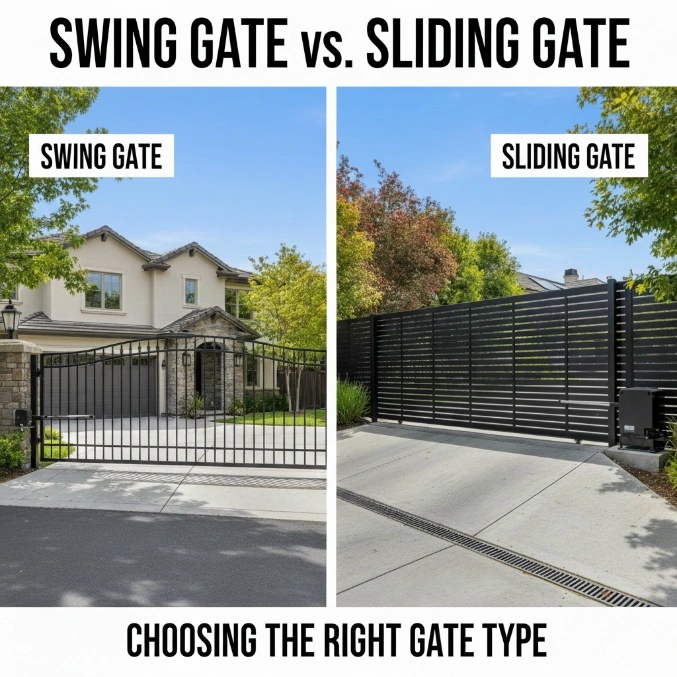
3. Swing Gates: Single vs. Double
If you have a level driveway and prefer the classic aesthetic of a swing gate, you have two main configurations:
- Single Swing: One large panel. This is often more cost-effective as it only requires one motor, but it requires the most depth (a 12-foot gate needs 12 feet of clear arc space).
- Double (French) Swing: Two panels that meet in the middle. This is a game-changer for tighter spaces because it halves the swing arc. Two 6-foot panels only require 6 feet of depth, making this a popular choice for properties in Folsom or Elk Grove that want a grand entrance without the massive footprint.
4. Sliding Gates: Tracked vs. Cantilever
When a swing gate isn’t an option due to space or slope, we look at sliding gates. However, not all sliding gates are built equal.
- Tracked Gates: These run on a metal track installed across the driveway. They are reliable and space-efficient, requiring only side-room to “park” the gate when open. As a rule of thumb, that parking run needs to be flat and slightly wider than the opening itself — the most common thing we measure for on a site visit.
- Cantilever Gates (The “Heavy Duty” Choice): Unlike tracked gates, a cantilever gate is suspended in the air and never touches the driveway.
- Best for Heavy Loads: If you have high traffic with heavy loads—such as forklifts, delivery trucks, or trailers—a cantilever gate is the best option. Since there is no track on the ground, there is nothing for a heavy vehicle to crush or for debris (like the pine needles common in Meadow Vista or Foresthill) to clog.
Note: These require about 40–50% more frontage space to the side for the counterbalance “tail.”
5. Local Safety and Fire Codes
Regardless of the style, your gate must meet UL 325 safety standards to prevent entrapment. Many fire districts also have requirements for gated driveways — commonly a setback deep enough for a vehicle to pull fully off the road while the gate opens, and emergency-access provisions so crews can get in. These vary district by district, so we design to your local fire district’s current requirements and recommend confirming them before fabrication.
How Much Does an Automated Driveway Gate Cost? (Swing vs. Slide)
Almost no gate company publishes these numbers, so here are ours. Start with the ladder that applies to both gate types:
- Adding an opener to a gate you already have: $5,000–$10,000 per operator, depending on operator size. A dual swing entrance needs two operators, so figure $10,000–$20,000.
- A complete new project — gate fabrication, installation, and automation: traditionally about double the opener-only cost: $10,000–$20,000 for a single gate, $20,000–$40,000 for dual swing gates.
Now the swing-vs-slide difference. The surprise for most customers is that the operators are roughly a wash: a 15-foot opening takes one slide gate operator or two swing operators (one per leaf) — the motor budget ends up about the same. The real difference is in the gate and the ground:
| Feature | Slide gate | Swing gate |
|---|---|---|
| Operator(s) | ≈ One operator for the opening | ≈ Two operators on a dual swing — about the same total |
| Gate panel(s) | ❌ Costs more to fabricate | ✔ Less expensive for the same opening |
| Safety hardware (ASTM) | ❌ Requires mesh/expanded metal or vertical pickets ~2″ on center — no reach-through openings | ✔ Standard UL 325 safety devices |
| Site work | ❌ Flat runout + concrete track — adds $4,000–$8,000 if grading is needed | ✔ Works with the existing ground in most cases |
| Shallow driveway at the road | ✔ Pull off the road and stop — no gate doors swinging toward your car | ❌ Needs the full swing arc kept clear of vehicles |
| Width beside the driveway | ❌ Needs a flat side run wider than the opening (20-ft driveway → ~22 ft of side room) | ✔ No side run needed |
| Driveway grades uphill | ✔ Slides along the fence line — grade doesn't matter | ❌ Can't swing in (panels hit the rising ground) — must swing out toward arriving cars |
| Wind resistance | ✔ Weight rides on the track — wind gets little leverage | ❌ Hangs from hinges — add a mag lock on windy sites |
Two cost drivers worth understanding before you fall in love with either type: slide gates must meet ASTM reach-through safety standards (mesh, expanded metal, or vertical pickets roughly 2 inches on center — and older slide gates usually need a retrofit before automation), and a slide gate needs a flat concrete run beside the driveway to slide onto — creating one on sloped ground typically adds $4,000–$8,000 in grading and concrete. Every site is quoted individually; estimates are free.
Which Gate is Your Match?
- Limited Side Room? Go with a Double Swing Gate.
- Limited Depth or Upward Slope? Go with a Sliding Gate.
- Heavy Industrial Use or Debris-Prone Area? Go with a Cantilever Sliding Gate.
FAQ: Swing vs. Sliding Gates
Which is cheaper: a swing gate or a sliding gate?
Usually the swing gate, for the same opening. The operators are roughly a wash (one slider motor vs. two swing motors on a dual gate — $5,000–$10,000 per operator either way), but sliding gate panels cost more to fabricate, need ASTM reach-through mesh or close-spaced pickets, and require a flat concrete run beside the driveway — which adds $4,000–$8,000 if grading is needed.
Can a swing gate work on a sloped driveway?
If the driveway slopes up from the road, an inward-swinging gate will bottom out against the pavement — its only option is swinging out toward arriving cars, which is rarely acceptable near a road. Uphill driveways are the clearest case where a sliding gate wins.
How much room does a sliding gate need to the side?
A flat run slightly wider than the opening itself, for the gate to park in when open (cantilever designs need roughly 40–50% more for the counterbalance tail). If your lot doesn’t have that width, a double swing gate is usually the answer — it halves the depth a single swing needs.
Get an Expert Opinion
Every property in the Greater Sacramento area is unique. Don’t guess on the measurements—let the pros help you design a system that is safe, legal, and built to last.
Ready to secure your property? Contact us today for a consultation:
- Email: info@callfantasticfence.com
- Phone: 916-713-5276
Serving: Sacramento, Folsom, Roseville, Rocklin, Auburn, Grass Valley, El Dorado Hills and surrounding areas