| The short answer: a gate intercom is how visitors reach you and how you let them in without walking down the driveway. In 2026 there are two real options. Basic voice (telephone entry) systems run $1,000–$3,500 for the unit and simply call your phone — you talk, press a key, the gate opens. Smart video intercoms video-call your phone so you can see the visitor: figure $2,000–$4,000 installed for a standard residential unit, and $2,500–$7,000+ for commercial, community, and more complex systems. Cellular models carry a monthly fee (roughly $45–$55 for voice plans, $50–$100+ for video platforms — plans change, so confirm current rates). And here’s the number nobody else will tell you: about 40% of our customers still choose voice — because “buzz people in” is sometimes the whole job. |
What Does a Gate Intercom Actually Do?
Option 1: Basic Voice (Telephone) Entry Systems
The traditional workhorse. A visitor presses the call button, the unit dials a pre-programmed number — your cell or landline — and you talk to them like any phone call. To open the gate, you press a tone key on your phone (for example, #9). Simple, familiar, and hard to break. The units we install most are DoorKing (DKS) 1800-series telephone entry systems (with a cellular adaptor where there’s no phone line) and units like the Linear AE-100.
Cost: $1,000–$3,500 for the unit, plus installation. Cellular voice plans run roughly $45–$55 per month — confirm current plans when you order, they change.
Best for: budget-conscious projects, properties where cell data coverage is thin (voice needs less bandwidth than video), and anyone whose honest use case is “I want to talk to the person and buzz them in.” That’s more people than the industry admits.
Option 2: Smart Video Intercoms
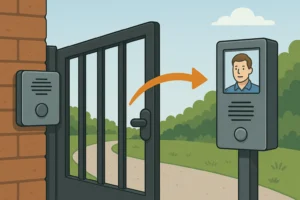
The modern standard for people who want to see who’s at the gate. The unit video-calls your smartphone: live video of the visitor, two-way audio, and a tap to open — from the kitchen or from another state. Every access event gets logged, and digital credentials (like QR codes and app-issued guest passes) come along for the ride. We install the LiftMaster CAPX series (CAPXS, CAPXM, CAPXLV — integrated with the myQ app) and the CellGate Watchman series (W450/WXL), which runs on AT&T and Verizon LTE for coverage flexibility.
Cost: $2,000–$4,000 installed for a standard residential unit; $2,500–$7,000+ for commercial properties, communities, and more complex multi-tenant systems. Video platform subscriptions typically run $50–$100+ per month depending on the system and plan — confirm current rates before you commit.
Best for: rental properties, frequent deliveries, families who want to screen strangers before the gate moves, and any property where “who came through, and when” needs an answer with video attached.
The Number Nobody Publishes: 40% of Our Customers Still Choose Voice
Every intercom article on the internet declares voice-only dead. Our install sheet disagrees: the split on new installs is roughly 60/40 video to voice. Video is better on paper — but voice keeps winning real decisions because it costs a third as much, has less to maintain, works beautifully on thin cell coverage, and completely solves the “let the gardener in” problem. Some customers also already have cameras covering the gate, so paying again for a camera in the intercom buys nothing new.
Our honest advice: buy video when seeing the visitor changes what you’d do — rentals, deliveries, kids home alone, logging. Buy voice when the job is recognizing a familiar voice and pressing a key. Both are good systems; only one of them is the right amount of system for your gate.
Voice vs. Video Intercom: Side by Side
| Feature | Basic voice entry | Smart video intercom |
|---|---|---|
| Hardware cost | ✔ $1,000–$3,500 for the unit | ❌ $2,000–$4,000 installed residential; $2,500–$7,000+ commercial/complex |
| Monthly fees (cellular) | ≈ ~$45–$55/mo voice plans | ≈ ~$50–$100+/mo video platforms |
| See who’s there | ❌ Audio only — you verify by voice | ✔ Live video on your phone before the gate moves |
| Access records | ❌ No visual log of who entered | ✔ Video-logged access events, digital guest credentials |
| Simplicity & upkeep | ✔ Fewer parts, familiar phone call, hard to break | ≈ App-based; more features, more to update |
| Thin cell coverage | ✔ Voice needs little bandwidth | ❌ Video streaming demands a stronger signal |
How Intercoms Connect to Your Gate Operator
A nice bit of 2026 progress: LiftMaster’s CAPX intercoms connect wirelessly to LiftMaster operators running firmware 4.2 or newer — no trench between the intercom pedestal and the operator. Traditional units (Linear, DoorKing voice systems) hardwire to the operator’s relay inputs, which is completely reliable and works with any brand. Either way, matching the intercom to your operator is our job — here’s how we compare LiftMaster and DoorKing if you’re choosing operators too.
Getting Signal to the Gate: Hardwired vs. Wi-Fi vs. Cellular
- Hardwired (Ethernet) — the gold standard. Fastest, most reliable, best video quality. The catch: it requires trenching a line from the gate to your router, which is real money on a long driveway.
- Wi-Fi — for short driveways only. If the gate sits close to the house and the signal is strong, Wi-Fi works. If the signal is marginal, video calls will drop exactly when someone’s waiting at the gate.
Cellular — what we install most. The unit has its own modem and SIM (CellGate units ride AT&T and Verizon LTE), so a gate a quarter-mile from the house gets full service with no trench and no Wi-Fi. The trade: the monthly data plan. And because cellular is only as good as the signal at your gate, we check it on site before recommending anything — some foothill pockets need the hardwired conversation instead.
What About Nimbio?
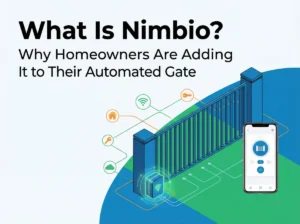
Different tool, different job. An intercom is for people you haven’t approved — they press a button, you answer, you decide. Nimbio is app-based access for people you have approved: your family, the housekeeper, rental guests with digital keys. No camera, no call button. Plenty of gates pair a video intercom (for strangers) with Nimbio or myQ (for regulars) — and if you’re mapping the whole access-control menu, here’s what’s real vs. hype in 2026 gate tech. |
FAQ: Gate Intercom Systems
How much does a gate intercom system cost?
Voice (telephone entry) units run $1,000–$3,500 plus installation. Smart video intercoms run $2,000–$4,000 installed for standard residential, and $2,500–$7,000+ for commercial, community, and complex systems. Cellular models add a monthly plan. For the rest of a gate project’s numbers, see the costs most quotes leave out.
Do gate intercoms have monthly fees?
Cellular models do — roughly $45–$55 per month for voice plans and $50–$100+ for video platforms, depending on the system and plan (rates change; we’ll confirm current pricing when we quote). Hardwired and Wi-Fi connections can avoid the cellular fee if your site supports them.
Can I see who’s at my gate from my phone?
Yes — that’s exactly what a smart video intercom does. Units like the LiftMaster CAPX series and CellGate Watchman video-call your smartphone: you see the visitor live, talk to them, and tap to open from anywhere.
Is a voice-only gate intercom still worth buying in 2026?
Yes — about 40% of our customers still choose voice. It costs a third as much, needs less signal and less upkeep, and completely handles the “talk to them and buzz them in” use case. Buy video when seeing the visitor actually changes your decision.
Does a video intercom need Wi-Fi at the gate?
Which video intercom is best — LiftMaster CAPX or CellGate Watchman?
Both are excellent; the site decides. CAPX is the natural fit with LiftMaster operators (wireless integration on firmware 4.2+, myQ app ecosystem). CellGate’s multi-carrier LTE flexibility can win on properties where one carrier’s coverage is weak. We match the unit to your operator, your signal, and how you’ll use it.
Get the Right Intercom for How Your Gate Actually Gets Used
We install voice and video entry systems on new gates and as upgrades to existing ones across Sacramento, Placer, El Dorado, Yolo, Yuba, and Nevada counties — and we check the signal at your gate before you spend anything. Licensed (CA #979657), bonded, and insured, since 2012.
Call (916) 713-5276 or request a free estimate online — we’ll tell you honestly whether your gate needs video, voice, or just a better keypad.