The short version: Hidden gate-installation costs come from two places — a quote written without seeing your property, and a quote that names a brand but not a model number.
The usual surprises, with real Sacramento-area numbers: running power to the gate typically adds $1,000–$3,000; the safety devices a lowball quote skipped run about $1,500 on residential gates and $3,500 on commercial; a keypad adds $500–$1,500 and a smart video intercom $2,000–$4,000; and if you want a slide gate, the concrete V-track run it rides on adds $4,000–$8,000 when the ground needs grading — the most forgotten line item of all.
HOA approval and fire-district requirements can reshape a project after the fact, too. Every one of these is knowable in advance — which is why we never quote a gate without a free on-site visit.
Where Hidden Costs Come From: No Site Visit, No Model Number
A gate quote can only hide costs that nobody looked for. In our experience, the quotes that blow up share one or both of these tells:
- Nobody walked the property. The distance to power, the slope of the driveway, the weight of the gate, what the fire district requires — none of it shows up in a phone estimate, all of it shows up on the invoice.
- The quote names a brand, not a model. “LiftMaster swing gate opener” sounds specific, but that phrase covers openers at wildly different sizes and prices — from a light arm operator to a heavy pad-mount machine. If the model number isn’t on the quote, you don’t actually know what you’re buying, and neither does the price.
A Real Example: The "Cheap" Quote We Had to Replace
A customer of ours thought she’d found a genuinely low-cost company to automate her gate. The quote said “LiftMaster swing gate opener” — no model number. What showed up was a small arm-style opener, badly undersized for her gate. The quote also included no photo eye safety devices. And she assumed her gate would open automatically when she drove up to leave, the way gates do in gated communities — she thought that was standard. It isn’t: that behavior comes from ground exit loops, which are an installed item, and her quote didn’t have them.
We ended up replacing the entire system: a pad-mounted LiftMaster CSW24UL sized for the gate, photo eye safety, and ground loops for automatic vehicle exit. Once she saw what the job actually required, the price difference between the quotes finally made sense — the low bidder wasn’t cheaper, they had just left most of the job out. The real difference between the two companies was simpler than price: we asked what she expected her gate to do. They never did.
The Usual Surprises — With Real Numbers
| The surprise | Typical added cost | Why it gets missed |
|---|---|---|
| Running power to the gate | $1,000–$3,000 | Phone quotes assume power is near the gate. Distance, conduit routing, and panel capacity decide the real number. |
| Concrete & grading for a slide gate’s V-track | $4,000–$8,000 | Everyone prices the gate and forgets the flat concrete run it slides on — the single most forgotten line item. |
| Safety devices (photo eyes, edges, loops) | ~$1,500 residential / ~$3,500 commercial | Required for UL 325 compliance — skipping them is the oldest trick for making a quote look cheap. |
| Automatic exit (ground loops / sensors) | Part of the safety & access package | Everyone assumes “the gate opens when I leave” is standard. It’s an installed feature — ask for it by name. |
| Keypad entry | $500–$1,500 | Often quoted as an afterthought — decide before the quote, not after. |
| Smart video intercom | $2,000–$4,000 | The most-requested accessory right now; wiring and programming are real work. |
| The right-size operator | Varies by model | An undersized arm opener costs less on paper and fails on your gate. The model number tells the truth. |
These are add-ons to the base project. For what the gate and opener themselves cost, see How Much Does an Automatic Driveway Gate Opener Cost in Sacramento? — and if you’re weighing a slide gate, the site-work math lives in our swing vs. sliding gate guide.
Electrical Runs: Still the Most Common Surprise
The gate needs power, and the power is wherever your panel is — not where the gate is. Trenching, conduit, wire gauge sized for the run, and connection work typically add $1,000–$3,000, with the distance from panel to gate doing most of the deciding. Boring under an existing driveway or upgrading a maxed-out panel pushes it higher. This is a five-minute measurement during a site visit, and a four-figure surprise without one.
Solar is a real alternative on the right property — no trench at all — but it’s not one-size-fits-all: high-traffic gates overwhelm small solar setups, and foothill winters demand honest panel and battery sizing. (Related: how long your gate runs during a power outage.)
The Slide Gate Surprise: The Concrete Nobody Budgets For
If you want a slide gate, here’s the line item people always forget: the gate has to slide onto something. That something is a flat concrete run alongside your fence line, slightly wider than the opening itself (a 20-foot driveway needs about 22 feet of side run), with the V-track the gate rides on mounted to it. If that ground isn’t already flat, it gets graded first. Together, the grading and concrete typically add $4,000–$8,000 to a slide gate project — and it almost never appears on a quote written without a site visit, because nobody can price dirt they haven’t seen.
That’s not a reason to skip the slide gate — it’s a reason to know the number before you compare quotes. The full slide-vs-swing cost math lives in our swing vs. sliding gate guide, and if you’re in the foothills, our Placer County slide gate guide covers whether your lot can carry one at all.
Safety Devices Are Code, Not Upsells
Photo eyes, reversing edges, and vehicle loops are what make an automated gate legal and safe under UL 325 — they’re how a several-hundred-pound moving gate notices your car, your dog, or your kid. Budget roughly $1,500 on a residential gate and $3,500 on commercial for a proper safety package. A quote without these line items isn’t a lower price; it’s an incomplete job. Slide gates carry one more requirement — reach-through protection under ASTM standards — which we cover in the swing vs. sliding gate guide. And operator sizing is its own safety issue: here’s how weight, length, and duty cycle actually determine the right opener.
Access Control: Decide What the Gate Should Do Before You Get Quotes
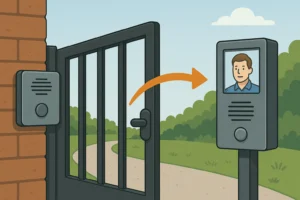
How will people get in? A keypad adds $500–$1,500. A smart video intercom — see who’s at the gate and open it from your phone — adds $2,000–$4,000 and is the accessory customers ask about most. Cellular call boxes, expiring guest codes, and app control round out the current menu (here’s what’s real vs. hype in 2026 gate tech). None of these are hidden costs if they’re on the quote — they become hidden when nobody asked what you expected the gate to do. Ask yourself: how do deliveries get in? Does the gate open automatically when you leave? Should the housekeeper’s code work on weekends? Those answers belong on the quote.
The Fine-Print Surprises: HOA Approval, Fire Districts, and ASTM Safety Standards
HOA and architectural review. In communities across Granite Bay, El Dorado Hills, Roseville, and the region’s 55+ neighborhoods, gate projects need architectural approval before fabrication — with specific requirements on height, style, and sometimes color. Skipping this step doesn’t save money; it buys a stop-work letter and a redo. We provide the drawings and specs your application needs.
Fire district requirements. Most Sacramento-area fire districts require gated driveways to provide emergency access — typically a Knox key switch or another approved override, plus a gate that stays operable during a power outage. Requirements vary district by district, and researching them and obtaining any permissions is the property owner’s responsibility — so contact your district ahead of time, before fabrication, and bring us the requirements; we’ll build the gate to meet them. A quote that never mentions your fire district is a quote that hasn’t thought about it.
ASTM safety standards. Automated gates are built to UL 325 and ASTM F2200 — and ASTM is the one that surprises people, because it governs the gate itself, not just the operator. Slide gates in particular must have reach-through protection: mesh, expanded metal, or vertical pickets spaced roughly 2 inches on center, so no one can reach through a moving gate. If you’re automating an existing gate, bringing it up to ASTM standards is often a required retrofit step — a real line item that lowball quotes silently skip. We check for it on every estimate, because a non-compliant gate is a safety and liability problem parked at the end of your driveway.
How to Compare Gate Quotes: A 7-Point Checklist
- Did the company physically walk the property before quoting?
- Is the exact operator model number on the quote — not just the brand?
- Are photo eyes, edges, and loops line-itemed — and does the gate itself meet ASTM reach-through standards (UL 325 / ASTM F2200 compliance)?
- Is the power run included, with the route and distance stated?
- Is your access control — keypad, intercom, remotes — specified and priced?
- If you expect the gate to open automatically on exit, are exit loops or sensors included?
- Are HOA approval and fire-district requirements accounted for?
If two quotes differ by thousands of dollars, run both through this list. In our experience the gap is almost never markup — it’s the items the cheaper quote left out, which you’ll pay for later anyway.
FAQ: Hidden Gate Installation Costs
What are the most common hidden costs in gate installation?
Running power to the gate ($1,000–$3,000), the concrete V-track run a slide gate needs ($4,000–$8,000 with grading — the most forgotten one), safety devices a lowball quote skipped (about $1,500 residential / $3,500 commercial), access control decided after the fact (keypads $500–$1,500, video intercoms $2,000–$4,000), an undersized operator that has to be replaced, and HOA or fire-district requirements discovered late.
How much does it cost to run power to a driveway gate?
Typically $1,000–$3,000 in the Sacramento area — trench, conduit, correctly sized wire, and connection. Long rural runs, boring under pavement, or panel upgrades push it higher; solar can eliminate the trench on the right site.
How much does the concrete track for a slide gate cost?
Typically $4,000–$8,000 for the grading and the flat concrete run the gate’s V-track mounts to — a pad alongside the fence line slightly wider than the opening (a 20-foot driveway needs about 22 feet of side run). It’s the most commonly forgotten cost in slide gate quotes. The full slide-vs-swing math is in our swing vs. sliding gate guide.
Are gate safety sensors really required?
Yes — UL 325 is the safety standard automated gates are built to, and photo eyes, edges, and loops are how a moving gate detects people and vehicles. Budget roughly $1,500 residential / $3,500 commercial for a proper package. A quote without them is incomplete, not inexpensive.
Why does the opener model number matter so much?
Because “LiftMaster swing gate opener” can mean a light arm operator or a heavy pad-mount machine — different capabilities, very different prices. Operators must be sized to the gate’s weight, length, and daily cycles; an undersized model fails early and gets replaced. Our operator sizing guide explains what to look for.
Does an automated gate open by itself when I drive up to leave?
Only if exit loops or exit sensors are installed — it’s not standard equipment, even though gated communities make it feel that way. If you expect that behavior, make sure it’s named on your quote.
How do I avoid hidden costs on my gate project?
Insist on an on-site estimate (ours are free, always), demand the exact operator model number, and run every quote through the 7-point checklist above. If a company quotes your gate without seeing your property, the missing costs haven’t disappeared — they’re just waiting.
Get a Quote With Nothing Hidden In It — Free On-Site Estimate
We never quote a gate project without walking the property — it’s the only honest way to price one. We specialize in the new installation, repair, and maintenance of automated gates across Sacramento, Placer, El Dorado, Yolo, Yuba, and Nevada counties. Licensed (CA #979657), bonded, and insured, since 2012.
Call (916) 713-5276 or request your free on-site estimate online — and bring the checklist.