| The short version: the “future of gate automation” mostly already arrived — it just looks different than the articles predicted. In our installs across the Sacramento region in 2026, the real changes are these: your phone is now the gate remote, video intercoms have brought doorbell-camera convenience to the driveway, cellular call boxes have killed the landline, battery backup became standard the moment PSPS outages became normal, and safety standards grew real teeth. License plate recognition is real too — mostly on commercial gates. Facial recognition at residential gates? Still hype. Here’s what we actually see, install, and recommend. |
The Future Already Happened: What Changed in Gate Automation Over Five Years
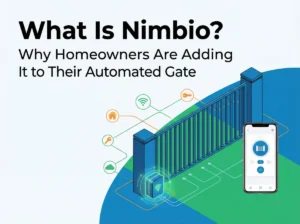
The app became the remote. This is the change we’re most excited about, because it changed how people live with their gates. Five years ago, phone control was an upsell; today it’s the default expectation. With platforms like myQ, your gate’s status lives on your phone — open it for a guest from the grocery store, get an alert when it opens at 2 a.m., hand the housekeeper a code that works Tuesdays only. Customers don’t ask “can it do that?” anymore. They ask why anyone would install a gate that can’t.
Battery backup became standard. When PG&E’s Public Safety Power Shutoffs became a fact of life in the foothills, backup power stopped being an accessory. A gate that stands dead — or worse, stands open — during an outage isn’t a security feature. Every system we design accounts for outage operation.
Safety standards got real teeth. UL 325 and ASTM F2200 compliance is now a bigger part of every job than any smart feature — monitored photo eyes and edges, and reach-through protection on slide gates (mesh, expanded metal, or pickets spaced so no one can reach through a moving gate). A growing share of our work is bringing older gates up to standard before automating them.
What Sacramento-Area Customers Actually Ask For in 2026
Two requests lead every conversation, whether the property is a Granite Bay estate or acreage outside Auburn:
- “Can I run it from my phone?” Yes — and this is the feature people end up using every single day: remote open for guests and deliveries, status checks, alerts, and temporary access codes.
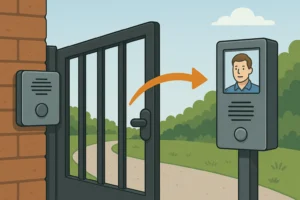
- “Can I see who’s at the gate?” The fastest-growing request. People have doorbell cameras at the front door and want the same thing at the driveway — see the visitor, talk to them, and buzz them in from anywhere.
The New Gate Accessories Worth Knowing About in 2026
Forget the sci-fi lists. These are the current-generation accessories we actually install and quote — and what each one solves:
- Smart video intercoms. Units like LiftMaster’s CAPX smart video intercom family put a camera and two-way video calling at your gate: a visitor presses the button, your phone rings with live video, and you open the gate from wherever you are. It’s the doorbell-camera experience, moved to the driveway — and it’s the accessory turning the most heads right now.
- Cellular call boxes. Telephone entry used to mean trenching a phone line to the gate. Current call boxes connect over cellular — no landline, no phone-line trench — which matters on long rural driveways where running copper was half the cost.
- Temporary and delivery access. Expiring PIN codes and app-issued guest passes solve the oldest gate problem: how the housekeeper, the pool service, and the delivery driver get in without your permanent code floating around. Codes can be limited to certain days and hours, and they shut off automatically.
- Loop-free vehicle detection. Exit sensors and vehicle detection that used to require saw-cutting loops into your driveway can now be done with wireless and radar-based sensors — less concrete work, easier retrofits.
AI at the Gate: What’s Real and What’s Hype
| Technology | Our verdict from the field |
|---|---|
| License plate recognition (LPR) | ✔ Real — mostly on commercial and community gates, where logging every vehicle matters and traffic volume justifies it. Residential requests exist but are rare. |
| Facial recognition | ❌ Hype for this market. Nobody orders it — a video intercom, keypad, remote, or app does the job without the privacy questions. |
| Smart video intercoms | ✔ Real and growing fast — the most-requested "new" accessory we install. |
| App control & alerts | ✔ Real and standard — this is the baseline now, not the future. |
Our advice: buy the technology that solves a problem you actually have. A video intercom solves “who’s at my gate.” An expiring PIN solves “the gardener needs in on Thursdays.” A plate reader on a home gate mostly solves a problem you don’t have yet — and adds a system to maintain.
Solar Gate Operators: The Honest Northern California Answer
Solar gate power is real and we install it — it’s the right answer on foothill and rural properties in Placer, Yuba, and Nevada counties where trenching power to the gate costs more than the operator. And through a Sacramento summer, solar runs effortlessly.
The honest part the brochures skip: winter is tighter. Shorter days, storm stretches, and foothill tree cover mean a solar system that coasted through July needs properly sized panels and battery capacity to stay reliable in January. That’s a design question, not a dealbreaker — we size solar systems for the worst month, not the best one, and we’ll tell you plainly if your gate’s location (deep shade, north-facing slope) makes grid power or a hybrid setup the smarter call.
Heat, Dust, and Fire Districts: What Gate Tech Still Has to Survive Here
No accessory matters if the system can’t handle where we live. Sacramento summers hold operators at 100°F-plus for weeks — heat is hard on control boards and batteries (here’s how we spec for it). Valley dust and wind interfere with cheap sensors; foothill properties add winter storms. This is a big part of why we install commercial-grade equipment from LiftMaster and DoorKing rather than lightweight kits — the smart features only matter if the gate still moves in August.
Fire access is the other local reality. Most Sacramento-area fire districts require gated driveways to provide emergency access — typically a Knox key switch or another approved override, and a gate that remains operable during a power outage (one more reason battery backup is standard on our installs). The exact requirements vary district by district, so we design each gate to its local district’s current rules and recommend confirming them before fabrication
FAQ: Gate Automation Technology in 2026
Can I open my driveway gate from my phone?
Yes — app control (myQ and similar platforms) is standard on the operators we install: remote open/close, status, open alerts, and temporary guest access from anywhere.
Can I see who’s at my gate before letting them in?
Do I need a phone line for a gate call box?
Not anymore. Modern call boxes connect over cellular, which eliminates the landline and the phone-line trench — a meaningful savings on long rural driveways.
How do delivery drivers get through my gate?
Expiring PIN codes or app-issued temporary passes — access that works for the delivery window and shuts off automatically, so your permanent code never gets shared around.
Is license plate recognition worth it for a home?
Usually not yet. LPR earns its keep on commercial and community gates that need to log every vehicle. At home, an app, remote, or video intercom covers the same need with less to maintain.
Does a solar gate opener work in winter here?
Yes, if it’s sized honestly: bigger panel and battery capacity than the summer minimum, and a site check for shade. We size for January, not July — and we’ll tell you if your gate location makes grid or hybrid power the smarter choice.
What does all of this cost?
It depends on the operator and the accessories you choose. We publish real numbers in our guide: How Much Does an Automatic Driveway Gate Opener Cost in Sacramento? — and financing is available. Estimates are free.
Planning a Gate Project? Get 2026 Technology With a Free Estimate
Our team installs, repairs, and modernizes automated gate systems across Sacramento, Placer, El Dorado, Yolo, Yuba, and Nevada counties — from app-controlled operators and video intercoms to solar packages and safety-standard retrofits. Licensed (CA #979657), bonded, and insured, since 2012.
Call (916) 713-5276 or request a free estimate online — we’ll tell you which of this technology your property will actually use, and which it won’t.