Automated gates all look like they came from the same family tree — steel frame, motor, maybe a keypad, and that satisfying moment when they glide open like VIP access to your own kingdom. But once you get past the surface, commercial and residential automated gates are two very different beasts.
If you’re a homeowner shopping for convenience and security, or a commercial property manager trying to keep traffic flowing without burning out your gate operator every three months, knowing the differences isn’t just helpful — it’s critical. Choosing the wrong setup is a quick way to end up with a gate that sounds like it’s asking for retirement.
So let’s break down what really separates commercial and residential automated gates, why it matters, and how to choose the right type for your property
1. Purpose and Usage: Light Duty vs. “This Gate Never Sleeps”
At the most basic level, commercial and residential gates are built for different lifestyles.
Residential Gates: Personal Convenience
A typical homeowner might use their gate:
- A few times in the morning,
- A few times in the evening,
- With some random Amazon deliveries in between.
We’re talking maybe 10–20 cycles per day, give or take. Residential operators — like many from Viking or LiftMaster’s residential line — are engineered for this lighter schedule. They’re reliable, smooth, and quiet, but they’re not meant to handle constant daily traffic.
Commercial Gates: High-Traffic, High-Stress
Commercial properties play by an entirely different rulebook:
- Dozens or even hundreds of vehicles daily,
- Constant entries and exits,
- No real “quiet” hours.
That’s why commercial operators are built with higher duty cycles, meaning they can run all day, every day, without throwing in the towel. Think apartment complexes, industrial yards, storage facilities, distribution centers — these places demand “no excuses” reliability.
In short:
Residential = casual everyday use.
Commercial = Olympic-level repetition.
2. How They’re Built: The Real Construction Differences
If you put a residential and commercial operator side-by-side, you’ll notice the difference the same way you notice the difference between a Toyota Corolla and a diesel work truck. Sure, they’re both vehicles… technically. But only one is built to tow a trailer full of concrete blocks.
Residential Operators: Lighter Components
Residential automated gate operators typically include:
- Smaller motors
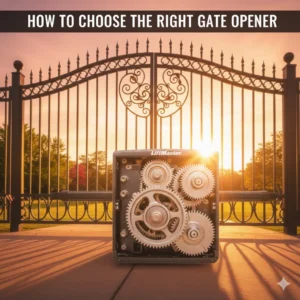
- Lighter gear assemblies
- Plastic or lighter-grade metal housings
- Standard-duty chains, drive arms, or belts
- Basic circuit boards and safety features
They’re engineered to be efficient, quiet, and reliable — but not overkill. There’s no point putting a 2-horsepower motor on a gate that only moves twice before you finish your morning coffee.
Commercial Operators: Built Like Tanks
Commercial operators step it up:
- Heavier, high-torque motors
- Metal gearboxes with hardened gears
- Thicker, reinforced chassis housings
- Stronger chains, tracks, or drive components
- Heat-dissipating design to prevent burnout under continuous use
- Advanced logic boards for controlling access, reporting errors, and integrating with large-scale security systems
Put simply, a commercial operator can move a gate that weighs as much as a car — and do it hundreds of times a day, without complaining.
This is why we often install:
- LiftMaster’s commercial line for most high-traffic sites
- DoorKing for heavy-duty, industrial, or HOA-level infrastructure
- Viking’s residential offerings where smoothness, noise reduction, and efficiency matter most
3. Gate Size and Weight: Bigger Property, Bigger Gate
This one seems obvious, but the implications run deeper than people think.
Residential Gates
Most residential gates:
- Are 12–16 feet wide,
- Weigh a few hundred pounds,
- Are usually designed more for appearance than brute strength.
Even a large wooden gate at home is still child’s play compared to many commercial setups.
Commercial Gates
Commercial gates can be:
- Massive sliding gates spanning 20–30+ feet
- Steel or industrial aluminum
- Thousands of pounds
- Exposed to harsher environments (wind load, traffic bumps, fork-lift “oops” moments, you name it)
That’s why commercial operators aren’t just “stronger”; they’re engineered specifically to handle weight, wind resistance, and continuous strain.
Your operator needs to match your gate’s weight like a trailer hitch needs the right towing capacity. Too small a motor on too big a gate is the fastest way to early equipment failure.
4. Power Supply: Solar for Homes, Hardwired for Business
This is where people get tripped up — especially when they hear the word “solar” and think it’s the eco-friendly, budget-friendly miracle for any gate.
Residential Solar: Yes, It Can Work Well
If you’ve got a quiet property with low daily usage, solar can absolutely power a residential gate. Many homeowners love the idea because:
- It eliminates trenching costs,
- It works in areas far from electrical access,
- It’s cost-effective and convenient in low-traffic environments.
But solar has one big limitation:
It can’t easily keep up with high-volume usage.
Commercial Solar: Probably Not Going to Cut It
Let’s be blunt — if you run a commercial property with regular traffic, trying to run your gate on solar is like trying to run a restaurant off a couple of AA batteries.
High-duty operators need consistent, reliable, high-output power.
Solar simply can’t recharge fast enough to keep up.
That’s why commercial installations almost always require:
- Direct electrical lines (dedicated circuits)
- Proper amperage
- Protected conduits
- Weather-rated power supplies
If you try to operate a commercial gate off solar, you may get one good day… followed by a week of angry tenants wondering why the gate only opens when the sun is “feeling generous.”
5. Safety and Security Features: One Is Optional, the Other Is Mandatory
Both commercial and residential gates include safety sensors, entrapment protections, and UL-325 compliance elements. But commercial settings take everything up a notch.
Residential Requirements
Homeowners typically need:
- Photo-eye sensors
- Basic safety edges
- Fire department access
- Simple keypad or remote access
- Limited security logic
Commercial Requirements
Commercial gates may require:
- Multiple redundant safety sensors
- Loop detectors for traffic flow
- Time delays and event logging
- Integration with large security systems
- Phone-entry or cloud-control access
- Anti-tailgating features
- High-speed opening where needed
Commercial operators often have more advanced logic boards and are built to communicate with more complex access control systems.
6. Lifespan and Maintenance: More Cycles, More Care
You’ll get many years out of both types if the operator matches the usage. But maintenance expectations differ.
Residential
- Simple annual checks
- Lubrication
- Battery replacement (if solar or DC backup)
- Basic wear-and-tear monitoring
Commercial
- Scheduled preventative maintenance
- Chain tension adjustments
- Gearbox lubrication
- Motor health checks
- Access control diagnostics
- Documentation for compliance
commercial gates operate like small industrial machines. And like any machine, they thrive on routine care.
7. Cost Differences: What You’re Really Paying For
Residential automated gates generally cost less — not because they’re “cheap,” but because they’re sized appropriately for lighter needs.
Commercial automated gates cost more because:
- Components are industrial-grade
- Operators are larger and more powerful
- Safety requirements are stricter
- Power infrastructure is heavier
- Access control systems are more advanced
If a commercial property owner tries to save money by installing a residential-grade operator, it will fail early. Not “maybe” — it will. And the replacement will cost more than choosing the correct operator from the start.
8. So Which One Do You Need?
Residential System If:
- You’re opening the gate less than 20–30 times per day
- It’s a home or small property
- You like the idea of a solar option
- You want smooth, quiet operation
- You don’t have heavy wind loads or oversized gates
Commercial System If:
- You expect regular or heavy traffic
- The gate is large or industrial
- You need continuous reliability
- Solar isn’t realistic
- You require robust security integrations
- You want an operator that can take abuse and keep going
Conclusion: They May Look Similar, but They Live Completely Different Lives
Commercial and residential automated gates aren’t interchangeable — not even close. One’s built for convenience. The other is built for endurance. One is designed for light, daily use. The other is a marathon runner that never stops.
At Fantastic Fence, we install both types and work with industry-leading brands like LiftMaster, DoorKing, and Viking to match the perfect operator to your exact needs.
Choosing the right automated gate system isn’t about the price tag — it’s about installing the setup that won’t leave you jammed, locked out, or explaining to tenants why the gate only works on sunny days.