Drive east along Interstate 80 from Roseville and in less than fifteen minutes the landscape shifts completely. The master-planned subdivisions and shopping corridors give way to oak-studded hillsides, horse arenas, and hand-painted farm stand signs. By the time you pass through Loomis and into the quiet backroads of Penryn, you’re in a different world—one where driveways are measured in hundreds of feet and your neighbor’s fence line is designed to keep horses in, not just for decoration.
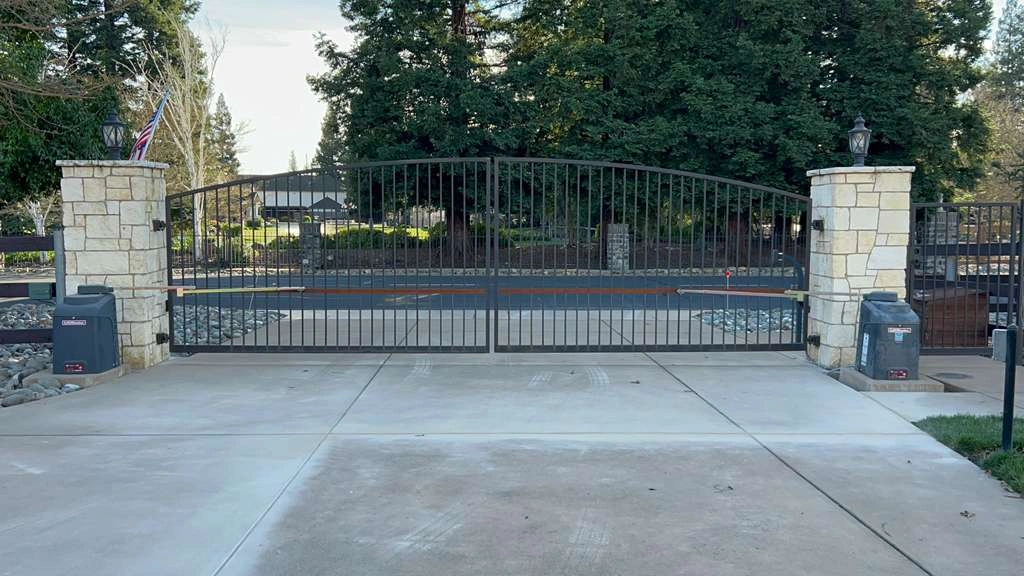
These three communities sit side by side in Placer County, but they couldn’t be more different in how people live—and that difference shows up in the automatic gates protecting their properties. A solar-powered slide gate on a five-acre Penryn ranch serves a fundamentally different purpose than a sleek, app-controlled entry gate in a West Roseville subdivision. And neither one looks or operates like the ornamental iron gates flanking the private estates of Loomis’s Clos Du Lac or Placer Canyon.
Here’s what we’re seeing across all three communities—and what it means for homeowners thinking about their next gate investment.
Loomis: Equestrian Country Meets Estate Living
Loomis is one of those rare communities that has fought hard to keep its rural character even as the surrounding area has urbanized. With a population of roughly 7,000 people and a strong agricultural heritage—the town still celebrates its annual Eggplant Festival—Loomis attracts homeowners who specifically want space, privacy, and the freedom to keep horses, livestock, or a small orchard right outside their back door.
The numbers tell the story. Homes in Loomis sell at a median price in the range of $715,000 to over $1 million depending on lot size and improvements, with properties routinely spanning two to ten acres. Single-family detached homes account for nearly 88% of the housing stock. And organizations like the Loomis Basin Horsemen’s Association—active since 1984—exist specifically to preserve the area’s equestrian trails and rural lifestyle.
This is a community where the gate at the end of your driveway isn’t a design accent. It’s a working part of the property.
What’s trending in Loomis:
Solar-powered gate operators are a natural fit for Loomis’s rural parcels. When your gate sits at the bottom of a long gravel driveway—hundreds of feet from the house and the nearest electrical panel—running conduit becomes a major expense. Solar eliminates that cost entirely, and with the Sacramento region’s 260-plus sunny days per year, these systems generate more than enough charge for daily operation. For horse property owners who may cycle their gate a dozen times a day between feeding, turnout, farrier visits, and riding lessons, solar systems with appropriately sized battery reserves handle the load without breaking a sweat.
Heavy-duty slide and swing operators built for rural conditions are another hallmark of the Loomis gate market. These aren’t the lightweight residential operators you’d find on a standard suburban driveway. Properties with wide agricultural entries, pipe gates, or heavy iron panels need operators with the torque and cycle capacity to handle the weight and frequency of daily ranch use. Dust, hay debris, and seasonal mud also demand operators that are sealed and rated for outdoor exposure—not consumer-grade units designed for a paved cul-de-sac.
Smart access with a practical edge is gaining traction among Loomis property owners. App-controlled gate openers allow homeowners to let in the hay delivery truck, the veterinarian, or a farrier without walking 400 feet to the gate in the summer heat. Some homeowners are pairing smartphone control with basic camera systems so they can see who’s at the gate before opening it—particularly valuable on isolated properties where the nearest neighbor may be out of sight.
The wildfire factor:
According to Redfin’s environmental risk data, approximately 99% of properties in Loomis carry some level of wildfire risk over the next 30 years. The combination of mature oaks, dry grass, and rural parcels with limited access roads creates a serious fire equation. For Loomis homeowners, an automatic gate that can’t open during a power outage doesn’t just trap your car—it can trap your horses, your livestock, and your family.
Every gate in the Loomis area should have a professionally maintained battery backup and a Knox Box for fire department access. If your operator is more than a few years old, the battery should be load-tested annually to confirm it will actually perform when the power goes out—because a degraded battery can fail at exactly the moment you need it most.
Penryn: Small-Town Privacy on Serious Acreage
If Loomis is the Sacramento foothills’ equestrian community, Penryn is its quieter, even more private sibling. This tiny unincorporated community of roughly 830 residents sits between Loomis and Newcastle along I-80, and it draws a very specific kind of buyer: someone who wants genuine rural seclusion with convenient freeway access to Auburn, Roseville, and Sacramento.
Penryn real estate is dominated by ranches, custom homes on oversized lots, and small farmhouses built on multi-acre parcels. The terrain here is quintessential Placer County foothills—oak-studded rolling hills, granite outcroppings, seasonal creeks, and long private driveways that wind through the landscape before reaching the home. Properties with two to seven acres are common, and several estates exceed ten acres. A handful of newer gated communities like Cambridge Estates and The Orchard offer a more polished option, but the majority of Penryn remains distinctly rural.
This is a community where your gate might need to keep cattle in, keep trespassers off a remote parcel, or simply provide peace of mind at the end of a dead-end road that only your family uses.
What’s trending in Penryn:
Solar-powered operators dominate the conversation here even more than in Loomis. Many Penryn properties have gate locations that are 300 to 600 feet or more from the home, with no existing electrical infrastructure anywhere near the road. Trenching costs through granite rock and tree roots can be prohibitive. A solar panel, charge controller, and deep-cycle battery system provides a self-contained power source that’s perfectly suited to Penryn’s sun-drenched hillsides.
Pipe gates and utilitarian designs are more common here than the ornamental iron seen in places like Granite Bay or El Dorado Hills. But there’s a growing trend among Penryn homeowners—especially those building new custom homes—to pair functional gate hardware with elevated design details. A ranch-style entry with a custom arch bearing the property name. Clean steel panel gates that complement a modern farmhouse build. These choices say “this is a working property” without looking like an afterthought.
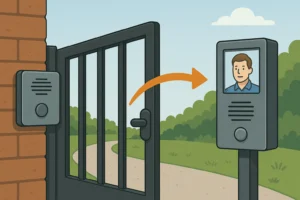
Intercom and camera integration serves a real security purpose on Penryn’s more isolated parcels. When you can’t see the road from your house, knowing who’s at the gate before you open it isn’t a luxury—it’s a practical safety measure. Modern systems that send a video feed to your smartphone let you verify delivery drivers, contractors, or unexpected visitors from anywhere on the property.
The wildfire factor:
Penryn shares Loomis’s extreme wildfire risk profile, with virtually every property in the area exposed to some level of fire hazard. The rural nature of many Penryn parcels compounds the risk—longer driveways mean longer evacuation routes, and many properties have limited turnaround space. A gate that fails during a power outage can create a dangerous bottleneck during an evacuation.
For Penryn homeowners, fire-readiness isn’t optional. Battery backup testing, Knox Box installation, and confirming that the manual release mechanism works smoothly should be annual maintenance priorities—not something you think about after the first smoke plume appears over the ridge.
➤ Own a property in Loomis or Penryn? We offer a free, no-cost, no-obligation on-site assessment and action plan. We’ll evaluate your entire gate system—from operator to battery to solar panel output—and give you a clear picture of where things stand. Whether you need a tune-up, a battery replacement, or a full operator upgrade, you’ll get a straightforward recommendation tailored to your property. Schedule your assessment here.
Roseville: Suburban Scale, Smart Solutions
Step across the city line into Roseville and the landscape changes dramatically. With a population of roughly 158,000 and a median home price in the $630,000 to $670,000 range, Roseville is the largest city in Placer County and one of the fastest-growing communities in the Sacramento region. Major employers like Bosch, Kaiser Permanente, and Sutter Health drive a steady influx of professionals and families looking for good schools, safe neighborhoods, and suburban convenience.
The housing stock here tells a different story than Loomis or Penryn. Master-planned communities like Westpark—a 1,500-acre development with 4,585 households—define much of West Roseville. Newer developments in the Sierra Vista and Fiddyment Farm areas continue to expand the city’s footprint. And established neighborhoods like Diamond Oaks, Sun City, and Morgan Creek serve everyone from young families to active-adult retirees.
Gate needs here are shaped by community structure, HOA standards, and a homeowner base that values technology, convenience, and clean design.
What’s trending in Roseville:
License plate recognition (LPR) is finding its biggest audience in Roseville’s gated communities and HOA-managed neighborhoods. Communities like Morgan Creek, Heritage Solaire, and the gated pockets within Diamond Oaks and Sierra Vista manage hundreds or thousands of vehicle entries daily. Traditional access methods—key fobs, clickers, call boxes—create bottlenecks, get lost, and are easily shared with unauthorized users. LPR eliminates all of that. Residents drive straight through. Visitors are pre-registered by the homeowner through an app. Unrecognized plates are logged and flagged automatically.
For HOA boards managing community budgets, LPR also reduces costs over time by lowering the need for guard staffing, replacing aging intercom hardware, and providing an automated audit trail that resolves gate-access disputes before they become board-meeting arguments.
App-based gate control and smart home integration resonate strongly with Roseville’s tech-forward homeowner base. Many buyers moving into West Roseville from Bay Area tech hubs expect their gate to be as connected as everything else in their home. They want to open the gate from their phone, receive alerts when it’s activated, see who’s at the entry via a linked camera, and integrate the whole system with their existing smart home platform. Modern gate operators make all of this possible—and for homeowners upgrading older systems, an operator replacement can bring this level of connectivity without replacing the gate itself.
Community gate reliability and high-cycle performance are constant concerns for Roseville’s HOA-managed properties. A community gate in a 500-home subdivision might cycle hundreds of times per day. Consumer-grade operators aren’t designed for that volume. Commercial-grade systems with high-cycle motors, heavy-duty gear drives, and redundant safety sensors are the standard—but even commercial equipment needs regular maintenance. Chains stretch, bearings wear, and safety devices drift out of alignment under heavy use.
HOA boards that invest in proactive annual maintenance packages avoid the reactive cycle of emergency repair calls, frustrated residents, and surprise assessments. A scheduled maintenance visit catches wear before it becomes a breakdown and keeps the system compliant with current UL 325 safety standards.
The wildfire factor:
Roseville’s wildfire risk profile is lower than Loomis or Penryn but still significant—roughly 83% of properties carry some level of fire risk over the next 30 years. The risk is especially elevated on the city’s eastern and northern edges, where development meets open grassland and foothill terrain. Newer communities in West Roseville built to current WUI (Wildland-Urban Interface) building codes have better structural protection, but the gate systems serving those communities still need functional battery backup for power-outage scenarios.
For individual homeowners with private driveway gates in Roseville’s eastern neighborhoods—closer to Granite Bay and the foothill interface—battery backup and fire department access provisions are every bit as important as they are in Loomis or Penryn. If your property sits near open space or wildland areas, a Knox Box and a load-tested battery should be part of your gate system, period.
What Connects These Three Communities
Despite the dramatic differences in property types and lifestyles, homeowners across Loomis, Penryn, and Roseville share the same fundamental expectations from their automatic gates:
Reliability that doesn’t depend on perfect conditions. Sacramento’s climate is hard on gate systems. Summer temperatures regularly exceed 100°F, baking operators and drying out seals and lubricants. Winter rains bring moisture, mud, and debris into tracks and sensors. On Penryn’s gravel driveways, dust is a year-round antagonist. In Roseville’s high-traffic community gates, sheer cycle count wears components faster than most homeowners or HOA boards realize. The gate that works perfectly in April can start grinding, stalling, or reversing by September if it hasn’t been serviced.
Safety that’s verified, not assumed. Modern gate safety standards under UL 325 require entrapment protection sensors that detect obstructions and reverse the gate before contact. But sensors drift out of alignment, get knocked by landscaping equipment, or accumulate dirt that reduces their sensitivity. An annual professional maintenance visit includes testing these devices under load—not just checking that a light turns on, but verifying that the gate actually stops and reverses when an obstruction is detected. For families with children, pets, or frequent visitors, this isn’t a technicality. It’s a life-safety issue.
Technology that earns its keep. Whether it’s LPR on a Roseville community gate, smartphone control on a Loomis ranch, or a camera-intercom system on a Penryn estate, the best gate technology doesn’t just add features—it solves specific problems. The Loomis homeowner who can open the gate for the vet without walking a quarter mile in July heat. The Roseville HOA board that eliminates a $3,000-per-month guard contract. The Penryn property owner who can verify a visitor’s identity before buzzing them through a gate they can’t see from the house. Technology works when it’s matched to how you actually live.
Is Your Gate System Keeping Up with Your Property?
One of the most common scenarios we encounter across all three communities is a homeowner who has invested significantly in their property—a new barn in Loomis, a kitchen remodel in Roseville, a custom farmhouse build in Penryn—while the gate system protecting that investment hasn’t been touched in a decade.
The operator still opens and closes the gate, but it lacks smartphone connectivity, has no camera integration, runs on a battery that hasn’t been tested in years, and uses safety technology that was current when the system was installed but has since been superseded by updated standards.
The good news: in most cases, an operator replacement or upgrade can bring an aging system into the modern era without replacing the gate structure itself. New operators add app control, LPR compatibility, improved battery backup with modern charging technology, and current safety compliance—all while mounting to the existing gate and hardware. It’s one of the highest-value improvements a homeowner can make: better security, better convenience, and better fire readiness without a complete tearout.
Your Property, Your Plan
Whether you’re on a ten-acre horse property in Loomis, a three-acre farmhouse parcel in Penryn, or in a master-planned Roseville community managing a shared entry gate, your system should be working as hard as you are to protect your home, your animals, and your investment.
If it’s been more than a year since your gate was professionally serviced—or if you’ve never had a full assessment done—now is the time. We serve homeowners and HOA boards throughout Sacramento, El Dorado Hills, Auburn, Elk Grove, Marysville, Grass Valley, and Galt.
➤ Schedule your free, no-cost, no-obligation on-site assessment and action plan today. We’ll come to your property, evaluate your entire gate system from operator to battery to safety sensors, and give you a straightforward recommendation—whether that’s a simple tune-up, a battery replacement, a solar system upgrade, or a full operator replacement. No pressure. No surprises. Just a clear plan tailored to your property and your neighborhood.