Real Project Spotlight: How We Helped a Sacramento Commercial Property Secure Its Parking Lot with an Automated Slide Gate
Every gate installation starts with a problem that needs solving. For this Sacramento area commercial property, the problem was straightforward: an open parking lot with no access control, no after-hours security, and no way to manage who was coming and going.
The property manager needed a solution that was durable enough for daily commercial use, reliable enough to operate in Sacramento’s punishing summer heat, and smart enough to give authorized personnel easy access without leaving the property vulnerable when the facility was closed. And it all had to fit within a practical budget—no ornamental iron, no over-engineered aesthetics. Just a gate that works, every time, for years.
Here’s what we built—and why each decision matters for commercial property owners across the Sacramento region.
The Challenge: An Unsecured Commercial Parking Lot
This property presented a scenario that’s extremely common across commercial sites in Sacramento, Elk Grove, and Roseville: a parking area serving a commercial facility with regular business-hours traffic but no control over who entered or when. After hours, the lot was completely open—accessible to anyone, including unauthorized vehicles, loiterers, and the kind of low-level property crime that plagues unsecured commercial sites throughout the region.
The property manager’s priorities were clear:
Control access during and after business hours so that only authorized vehicles could enter the lot while the facility was in operation, and the entire perimeter could be locked down when the building was closed.
Maintain fire department access at all times — a non-negotiable requirement for any commercial property with a gated entry in California.
Keep the system operational during power outages so the gate wouldn’t become a liability during Sacramento’s occasional grid events or planned shutoffs during wildfire season.
Enable remote management so authorized staff could open the gate from their phone without being physically present at the property.
And critically: stay within a commercial budget that prioritized function, durability, and long-term reliability over aesthetics.
The Solution: A Commercial-Grade Chain-Link Slide Gate
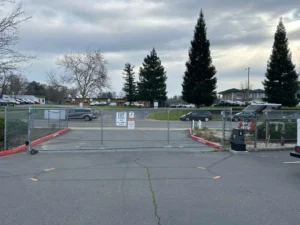
After an on-site assessment, we designed and installed a system built around a heavy-duty chain-link slide gate—the workhorse of commercial perimeter security. Here’s why each component was selected and what it delivers for this property.
Chain-Link Slide Gate: Built for the Job
For a commercial parking lot entrance, a slide gate is almost always the right call. Unlike swing gates—which require a wide clearance arc and can be impractical in tight parking configurations—a slide gate travels laterally along a track, tucking neatly alongside the fence line when open. This means vehicles can pull through without waiting for a gate panel to swing out of the way, and the gate doesn’t eat into usable parking space.
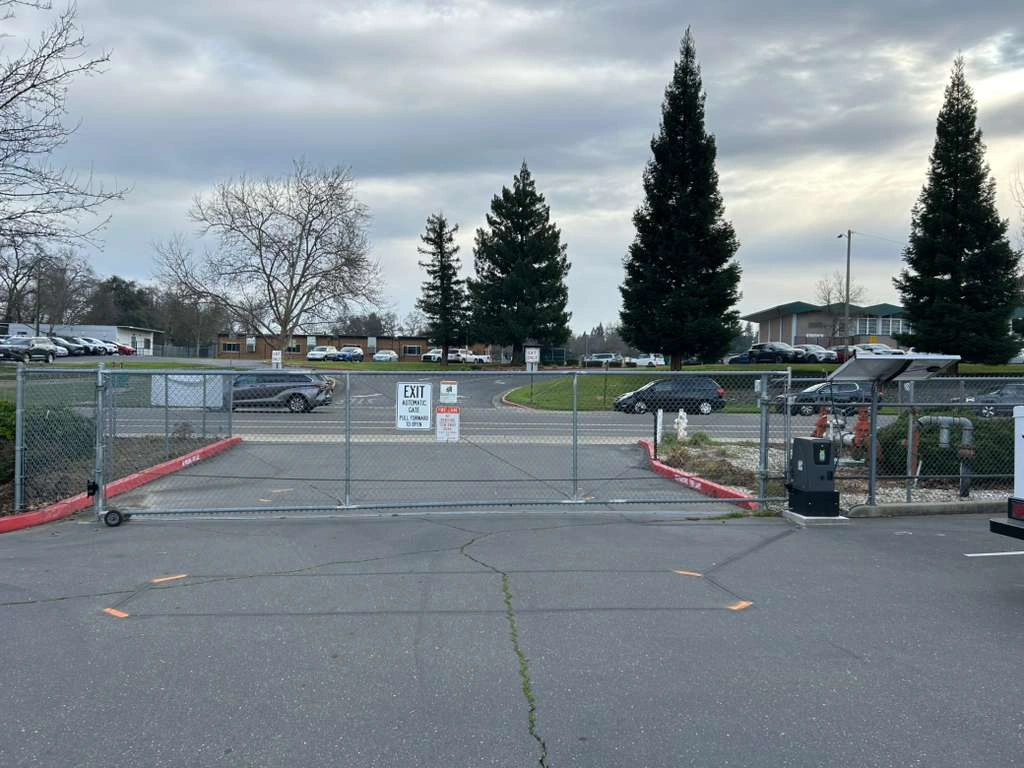
Chain link is the material of choice for commercial applications because it delivers exactly what’s needed: visibility (staff and security cameras can see through the gate), durability (galvanized steel stands up to years of weather, UV exposure, and daily use), and cost-effectiveness (more gate for less money compared to ornamental alternatives). It integrates seamlessly with existing chain-link perimeter fencing—which is exactly the case at this Sacramento property.
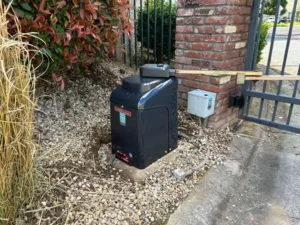
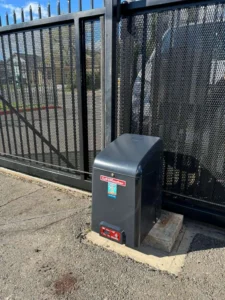
The gate is sized to accommodate standard vehicle traffic including delivery trucks, and the commercial-grade slide operator is rated for the high cycle counts that a busy parking lot demands. This isn’t a residential operator repurposed for a commercial site—it’s built from the ground up for properties where the gate may cycle dozens or even hundreds of times per day.
Battery Backup: The Gate Works When the Power Doesn’t
Power outages happen in Sacramento. Whether it’s a grid failure during a summer heat wave, a planned PSPS (Public Safety Power Shutoff) during wildfire season, or a localized electrical issue, any business that relies on an automated gate needs to know the system will keep running when the lights go out.
This installation includes an integrated battery backup system that automatically engages when AC power is lost. The battery provides enough capacity for multiple open-close cycles, ensuring that authorized personnel can still enter and exit the property—and that the gate can be secured in the closed position if needed—during an extended outage.
But here’s the detail that many property managers overlook: batteries degrade over time. A backup battery that was fully functional when it was installed three years ago may have lost a significant portion of its capacity. The only way to know for certain is to have the battery professionally load-tested on a regular schedule. An annual maintenance visit includes this test, so you’re never guessing about whether your backup will actually back you up.
UL 325 Safety Sensors: Compliance Isn’t Optional
Any automated gate in a commercial setting must comply with UL 325, the national safety standard for gate operators. UL 325 requires entrapment protection devices—sensors that detect obstructions in the gate’s path and reverse or stop the gate before contact occurs.
This installation includes photoelectric sensors positioned across the gate opening that detect vehicles, pedestrians, or any other obstruction in the gate’s travel path. If the beam is broken while the gate is closing, the operator reverses immediately. The system also includes signage and visual indicators that alert pedestrians and drivers that the gate is automated—clearly visible in the photo posted above.
For commercial property owners and managers across Auburn, El Dorado Hills, and the greater Sacramento area, UL 325 compliance isn’t just a recommendation—it’s a legal and liability issue. A gate system that lacks proper safety devices, or one where the sensors have drifted out of alignment and no longer function correctly, exposes the property owner to significant risk. Regular maintenance ensures these devices are tested and verified, not just assumed to be working.
Knox Box: Fire Department Access, No Delays
California fire codes require that emergency responders be able to access gated commercial properties without delay. A Knox Box mounted at the gate entry provides fire departments with a secure, standardized access point. Firefighters carry a master key that opens the Knox Box, which contains the gate release mechanism or override key.
This is a non-negotiable component for any commercial gate installation. Without it, fire crews may need to force the gate open during an emergency—damaging the gate, delaying response time, and potentially creating a more dangerous situation. A Knox Box eliminates all of that with a simple, proven system that costs very little relative to its importance.
For business owners in areas with elevated wildfire risk—including properties in Grass Valley, Marysville, and the foothill communities—Knox Box installation should be a baseline requirement, not an afterthought.
Remote Access: Open the Gate from Anywhere
The property manager for this Sacramento facility needed the ability to grant access without being physically present. Modern gate operators with app-based control make this straightforward. From a smartphone, authorized staff can open the gate for a delivery driver, a maintenance contractor, or an employee who arrives outside of normal business hours.
This capability transforms how a commercial property is managed. No more driving to the site to let someone in. No more leaving the gate open “just in case.” No more sharing access codes that inevitably get passed to unauthorized people. The property manager controls who gets in, when they get in, and has a record of every activation.
For multi-site property managers overseeing facilities across Sacramento, Elk Grove, Galt, and beyond, this kind of remote oversight is a game-changer. One person can manage access across multiple properties from a single phone.
Why This Project Matters for Commercial Property Owners
This installation isn’t flashy. It’s not the kind of gate that wins design awards or gets featured in architecture magazines. But that’s exactly the point.
For commercial properties, the best gate system is the one you don’t have to think about. It opens when it should. It closes when it should. It keeps unauthorized people out. It lets authorized people in. It works during power outages. It complies with safety standards. And it gives fire departments instant access in an emergency.
This Sacramento installation does all of that—reliably, durably, and within a budget that makes sense for a commercial operation. And because the system is backed by an annual maintenance package, the property manager knows that the operator, the battery, the safety sensors, and the Knox Box are all professionally inspected and verified every year. Problems are caught before they become failures. Compliance stays current. And the gate just works.
Questions We Hear from Commercial Property Owners
We already have a fence. Can we add a gate to the existing perimeter?
In most cases, yes. A chain-link slide gate can be designed and installed to integrate with your existing fence line. We assess the site, confirm the opening width, evaluate the surface and grade, and recommend the right operator for the expected traffic volume. This project is a perfect example—the new gate connects directly to the property’s existing chain-link fencing.
How often does a commercial gate need maintenance?
At minimum, annually. Commercial gates cycle far more frequently than residential systems, which accelerates wear on chains, rollers, tracks, and operator components. Safety sensors need to be tested under load, not just visually inspected. Battery backup needs a professional load test to confirm actual capacity. And the operator itself needs lubrication, alignment checks, and firmware or settings verification. An annual maintenance visit addresses all of it.
Do I need a Knox Box if I already have a manual release?
A manual release is important, but it requires someone to physically operate it. In an emergency, fire crews need access immediately—they can’t wait for a property manager to arrive and release the gate. A Knox Box provides that instant access using a standardized key system that fire departments carry. It’s a small investment that can make a critical difference during an emergency.
Is Your Commercial Property’s Gate System Up to the Task?
Whether you’re managing a single commercial site in Sacramento or overseeing multiple properties, we can help you evaluate what you have, identify what’s missing, and build a system that delivers real security—not just the appearance of it.
➤ Schedule your free, no-cost, no-obligation on-site assessment and action plan today. We’ll visit your property, evaluate your perimeter and access needs, assess any existing gate equipment, and give you a clear, straightforward recommendation. Whether you need a full new installation like this Sacramento project, an operator upgrade on an existing gate, or an annual maintenance package to keep your current system compliant and reliable—we’ll lay it all out with no pressure and no surprises.