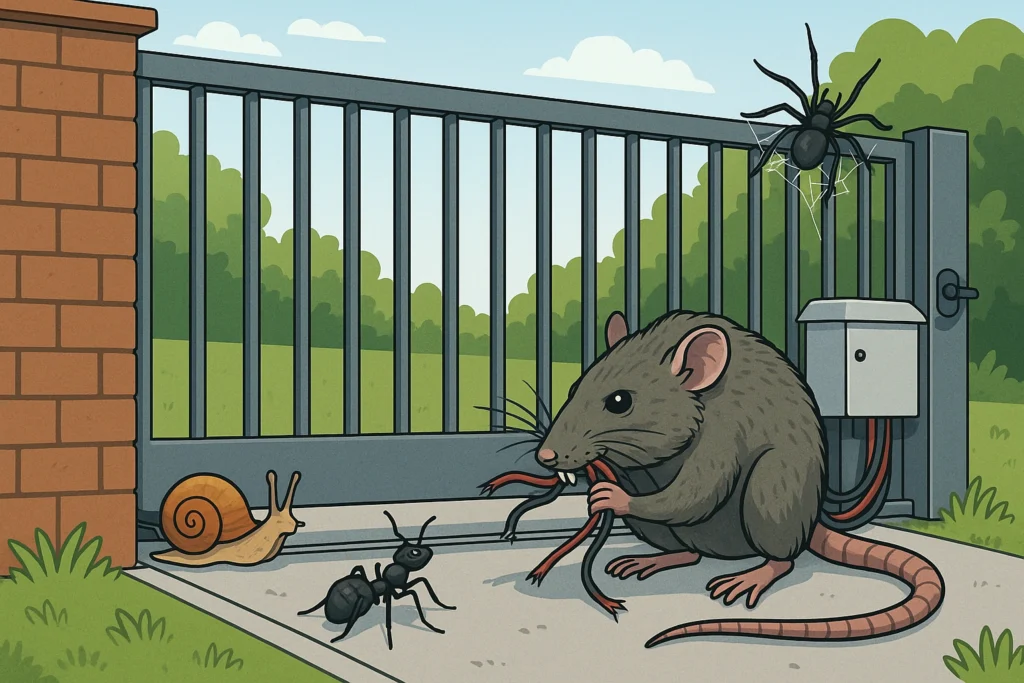
You press the remote. Nothing happens. You check the battery, check the breaker, walk down to the gate—and when you open the operator housing, you find the real problem: a nest of chewed wires, a circuit board crawling with ants, or a slug trail bridging two contacts that should never touch.
This isn’t a rare scenario. Across the Sacramento region—from suburban properties in Roseville and Elk Grove to rural lots in Auburn, Grass Valley, and El Dorado County—pest damage is one of the most common causes of “mystery” gate failures we see on service calls. Gate operators generate heat and provide enclosed shelter, which makes them attractive to insects and rodents year-round. Sacramento’s hot summers drive pests toward any shaded, protected structure, and the cooler months push rodents indoors aggressively—roof rats are the single biggest rodent concern in the Sacramento Valley from November through February.
Here’s the breakdown of the most common offenders, the damage they cause, and how we address it during preventive maintenance visits.
The Usual Suspects: What’s Attacking Your Gate Operator
Rodents (the wire chewers). Rats and mice chew constantly to file down their incisors, which never stop growing. Their teeth rank 5.5 on the Mohs hardness scale—harder than iron and copper—which means your gate’s wiring harness, low-voltage control wires, and even the insulation on higher-gauge power lines are easy targets. A rodent colony in an operator housing can strip wire insulation overnight, causing shorts, blown fuses, and—in the worst cases—electrical fires. Nationally, rodents are estimated to cause 20–25% of house fires attributed to “unknown causes,” and the same risk applies to any outdoor electrical equipment with exposed wiring. In the Sacramento area, properties backing up to open land, creek corridors, or agricultural fields in Auburn, Marysville, and Galt are especially vulnerable because rodent populations are denser near natural habitat.
Ants (the circuit board destroyers). Certain ant species are attracted to the electromagnetic fields generated by energized electrical components. When ants crawl across a live circuit board, their bodies can bridge contacts and create short circuits. A single ant death on a board can release alarm pheromones that attract more ants to the same spot, compounding the problem rapidly. We’ve opened operator housings on properties in Folsom and Granite Bay to find circuit boards completely coated in dead ant colonies—with the board shorted beyond repair. Argentine ants, one of the most prevalent species in the Sacramento Valley, are particularly prone to invading electrical enclosures.
Spiders and wasps. While they don’t directly damage electronics the way rodents and ants do, spiders build webs across photo eye sensors—blocking the infrared beam and preventing the gate from closing. Mud dauber wasps build nests inside operator housings and conduit openings, obstructing wiring access and creating maintenance headaches. Both are extremely common in the Sacramento area’s warm months.
Slugs and snails (the slimy saboteurs). A single slug crossing a circuit board leaves a moisture trail that is electrically conductive. That trail can bridge contacts that should never be connected, creating unpredictable short circuits and erratic gate behavior. The damage is often invisible until the board malfunctions—by that point, the corrosion from the moisture trail may have already destroyed traces on the PCB. Slug damage is most common during Sacramento’s wet winter months, particularly on properties with landscaping or ground cover near the operator pad.
What to Do If You Find Pests in Your Operator Housing
If you open your operator box and see pests, STOP. Do not grab the garden hose.
- Cut the Power: Before touching anything, turn off the breaker dedicated to the gate and disconnect the battery backup.
- Dry Clean Only: Use a soft paintbrush or a can of compressed air to gently sweep away the pests. Do not use water or liquid sprays.
- Clean Slime Trails: If you see a slug or ant trail across the circuit board, you may attempt to clean it with a Q-tip dipped in 90% Isopropyl Alcohol. If the board looks burnt, the damage is likely permanent.
- Assess the Wiring: If you see exposed copper wires that have been chewed, do not turn the power back on. Call a professional.
The Best Defense: How to Pest-Proof Your Gate System
You can’t control nature, but you can make your gate operator a fortress using these professional-grade strategies.
1. Seal the Entry Points With Specialty Barriers
- Most pests enter through the conduit (the pipe that brings the wires up from the ground).
- The Fix: Use Stainless Steel Wool or copper mesh to stuff the gaps around the wires where they enter the box. For a professional-grade seal, consider using products like Xcluder® Rodent Control Fill Fabric or Polywater® FST™ Duct Sealants, which are specialty materials rodents cannot chew through.
2. Protect The Electronics with Dielectric Coatings
This is the ultimate preventative step used in the electrical utility industry.
- The Concept: Specialty dielectric (non-conductive) sprays form a high-voltage barrier on the circuit board, physically preventing ants, slugs, and moisture from causing shorts.
- Product Example: Look for industrial products like JS 685® Spray or similar Acrylic Conformal Coatings that are specifically formulated to create a protective, insulating film on circuit boards and electrical connections.
3. Targets, Non Repellent Chemical Controls
You need to kill the colony without contaminating the electronics.
- The Fix: Place contained insect bait stations (like Maxforce FC for ants and roaches) on the inside walls or floor of the control box. Pests eat the bait and carry it back to the colony, eliminating the source of the problem.
- Avoid: Never use repellent sprays inside the box, as the chemicals can cause corrosion.
4. Work with your Existing Pest Control Service
If you already pay a pest control company to spray your home, don’t let them ignore the driveway.
- The Tip: Explicitly ask your service technician to inspect and treat the area around your gate operator and the arm setup during their regular visits. They can create a chemical barrier around the concrete pad that stops ants and rodents before they even reach the housing.
Why Annual Maintenance Is the Real Pest Defense
The DIY prevention tips above work—but they require a homeowner to remember to check the operator housing, climb down to the gate pad, open the box, and inspect components they may not be familiar with. In practice, most people don’t do this until something breaks.
That’s why our annual maintenance plan includes pest inspection and prevention as a standard part of every service visit—not as an add-on. When we open the operator housing for the annual tune-up, we’re already inspecting the control board, testing the battery backup, verifying sensor alignment, adjusting chain tension, and lubricating moving components. Adding pest inspection, debris removal, entry point resealing, and bait replacement to that visit costs nothing extra and catches infestations before they become repair bills.
The math is straightforward: a control board replacement on a LiftMaster or DoorKing operator can cost $300–$800 depending on the model. A full wiring harness repair after rodent damage can run $500–$1,200. A $5 mouse or a $0 ant colony can destroy components worth ten times or more than the annual maintenance investment that would have caught them. Don’t let the cheapest pest on your property create the most expensive repair.
At Automated Gate Company, we serve homeowners across Sacramento, Placer, El Dorado, and Nevada counties. Whether your system needs a pest-related repair right now or you want to get ahead of the problem with scheduled maintenance, we’re here to help.
Call (916) 713-5276 or contact us online to schedule a service visit or learn about our maintenance plans.