Summary of Concerns | |
Durability | Light-duty components (gears, control boards) are prone to premature failure and susceptible to moisture/weather. |
Repair | High rate of part obsolescence; replacement parts are often unavailable, forcing customers to buy entire new units instead of a simple repair part. |
Reliability | Designed for extremely low-frequency use and are highly intolerant of slight gate imperfections, leading to rapid wear and erratic operation. |
Long-Term Cost | Low initial price is offset by high long-term replacement frequency and lack of labor coverage for warranty failures. |
Introduction: The Challenge of the DIY Opener
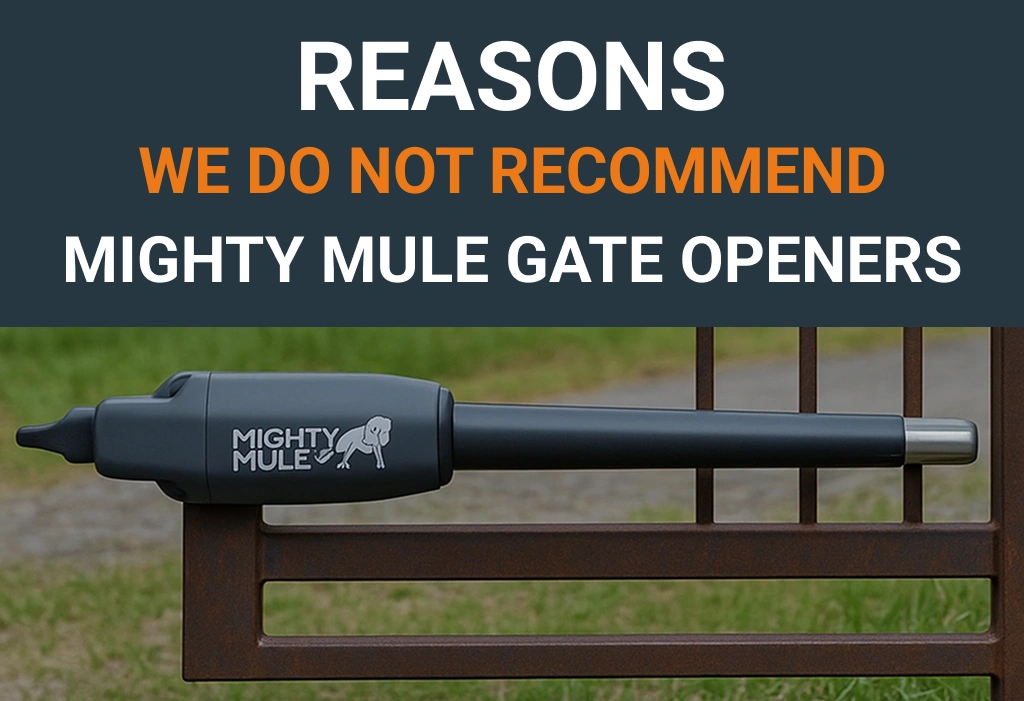
The Mighty Mule brand of gate openers has built a reputation based primarily on accessibility and DIY installation. While this makes them appealing to the budget-conscious homeowner looking for a weekend project, the compromises necessary to achieve that low barrier to entry often lead to significant long-term frustration, high maintenance, and poor reliability compared to professional-grade systems.
Here are the primary reasons why professional gate installers often advise against using Mighty Mule gate openers:
1. Reliability and Durability Issues
Mighty Mule systems are designed for light-duty, residential use. This is reflected in the quality and strength of their core components, which often fail under normal operating stress.
- Limited Duty Cycle and Stress: These openers are not designed for high-frequency use. They work best on gates that open and close only a few times a day. If you live on a busy road or run a business, the high duty cycle will wear out components rapidly.
- Weather and Moisture Sensitivity: Numerous reports indicate that the arm actuators and control boards are susceptible to moisture intrusion. This can lead to the failure of internal components like the revolution counter boards, resulting in erratic operation or complete failure.
- Internal Component Weakness: Unlike heavy-duty commercial openers, internal parts like gears and shafts are often cited as being under-spec for the job. User reviews sometimes mention plastic gears or shafts that bend easily, leading to premature failure (Source: Reddit discussions on new models).
2. The High Cost of Repair and Obsolescence
What initially seems like a budget-friendly purchase quickly turns into a major expense due to poor repair options and a rapid turnover of models.
- Difficulty Finding Replacement Parts: The company has a history of obsoleting models and components quickly (Source: BBB complaints). A user may find that after just a few years of operation, a key component like an arm actuator or control board is no longer available, forcing them to purchase an entirely new system rather than a simple, inexpensive repair part.
- Poor Post-Warranty Support: While technical support is available for troubleshooting, customers often report that once the system is out of warranty, their only resolution for a complex failure is to buy a new unit, leading to a “disposable” product mentality.
- Non-Standard Components: Certain internal parts, while sometimes repairable with generic motors, require the homeowner or installer to become an amateur electronics expert, complicating what should be a straightforward fix.
3. Technical and Installation Limitations
The DIY nature of the system imposes strict physical and electrical limitations that can be difficult or expensive to overcome.
- Low Voltage Requirements & Setup Risks: Mighty Mule systems operate on a 12-volt battery system that is trickle-charged by a transformer. The installer must adhere to specific rules, such as using a minimum of 10 feet of low-voltage wire between the outlet and the control box. Using less wire can overpower and damage the control circuit.
- Antenna and Signal Weakness: Customers frequently complain about poor remote signal range. The antenna is often housed within the control box, and issues like electrical “noise” from other nearby wiring or poor antenna placement can prevent the remote from working unless the car is right up against the gate (Source: Reddit troubleshooting).
- Gate Condition Dependency: The manufacturer is clear: Mighty Mule openers will only work on gates that are perfectly plumb, level, and swing or slide freely. Unlike heavy-duty operators that can compensate for minor imperfections, the low power of these units means they will fail prematurely if the gate is poorly constructed or the post settles.
4. Limited Professional Applicability
Professional-grade operators from brands like LiftMaster or Linear Pro are built to industrial standards, offering features Mighty Mule simply cannot compete with:
- Lack of Advanced Features: Mighty Mule units typically lack the advanced logic and connectivity offered by professional systems, such as advanced safety features, sophisticated access control integration, and robust smart home connectivity.
- Gate Weight/Length Limitations: While the brand offers various models, even their heavy-duty models are often insufficient for truly large, heavy, or ornamental gates compared to industrial alternatives.
- No Compensation for Labor: If a unit fails under warranty, Mighty Mule will often replace the part, but they do not cover the labor cost for the installer or the homeowner to make multiple trips to troubleshoot and swap out defective equipment. This leaves the installer or end-user footing the bill for wasted time.
The Bottom Line
While a Mighty Mule unit might work adequately for a perfectly balanced, lightweight gate with minimal use, its limitations in component strength, resistance to weather, and the long-term risk of part obsolescence make it a questionable investment for reliability-minded property owners. For a gate you need to depend on every day, investing in a true professional-grade system ultimately saves time, frustration, and money.
Ready to find a reliable and affordable gate opener? We are here to help show you all your options. Contact Us Today!