Your automated gate’s operator is the muscle. The sensors are the brains. They’re what prevent the gate from closing on your kid’s bike, what detect your car approaching so you don’t have to roll down the window in the rain, and what keep the system from operating when something isn’t right. Some of these sensors are legally required. Others are optional upgrades that make daily life dramatically easier. And a few—like license plate readers—are transforming how Sacramento-area properties manage access entirely.
This guide explains each sensor type we install, what it does, when it’s required versus when it’s a smart addition, and the Sacramento-specific conditions that affect how they perform over time.
Sensors That Make Your Gate Smarter: Convenience and Access Control
Every automated gate installed in the United States must comply with UL 325, the safety standard for vehicular gate operators. For residential systems (Class I), UL 325 requires a minimum of two independent entrapment protection devices for each direction of gate travel. Since the 7th Edition took effect in 2018, operators must also monitor connected safety sensors at least once per cycle—if a sensor fails or loses connection, the gate will not operate. This isn’t a suggestion. It’s a compliance requirement, and it’s the reason your gate shuts down when a sensor has a problem rather than just ignoring it. For a deeper look at how safety requirements differ between residential and commercial installations, see our operator comparison guide.
1. Non-Contact Sensor: The Photo Eye (or Photocell)
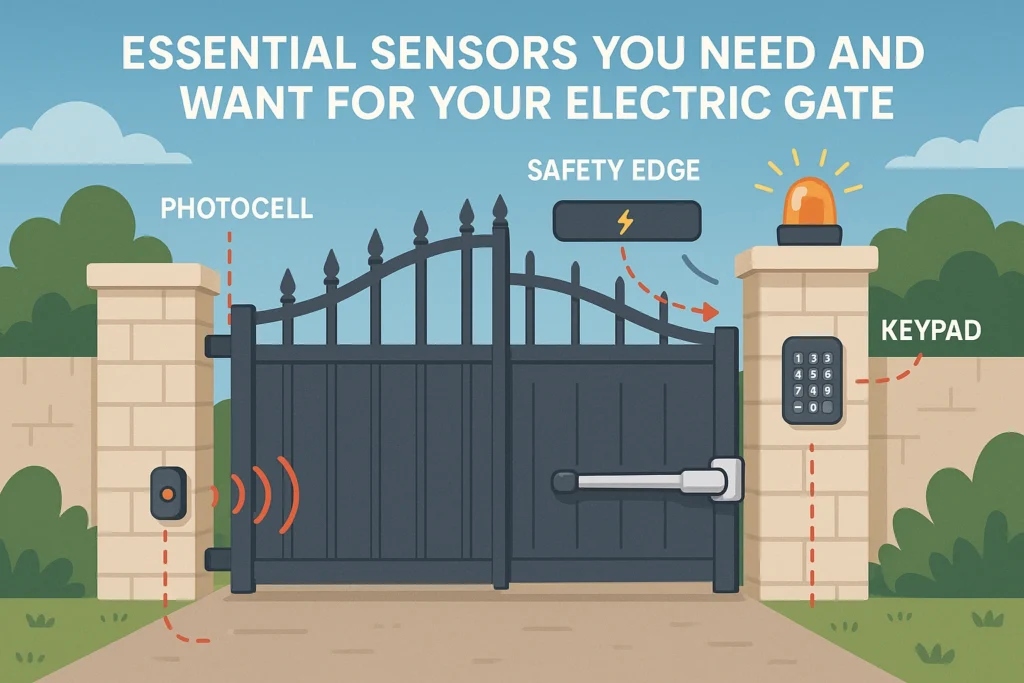
Photo eyes are infrared beam sensors mounted on opposing sides of the gate opening. A transmitter sends an invisible beam to a receiver; if anything breaks that beam while the gate is closing—a person, pet, vehicle, or bicycle—the operator immediately stops and reverses the gate. They’re your primary line of defense because they detect obstructions before the gate makes contact.
On every installation, we position photo eyes at two heights: one set low (approximately 6 inches off the ground) to catch small children and pets, and a second set higher to catch adult-height obstructions. The sensors are mounted inside the gate area to prevent closing on something in the path, and in some configurations outside the gate to ensure the immediate approach zone is clear before the gate begins moving.
In the Sacramento area, photo eyes are the sensor most affected by environmental conditions. Spider webs across the lens are the single most common cause of “gate won’t close” calls that turn out not to be a mechanical problem. Dust accumulation during dry summers, fog condensation during Tule fog season, and direct afternoon sun glare can also cause false triggers or beam interruption. During annual maintenance visits, we clean all photo eye lenses, verify beam alignment, and check for vegetation encroachment that can gradually obstruct the sensor path between visits.
2. Contact Sensor: The Safety Edge (or Bump Edge)
Safety edges are pressure-sensitive rubber strips mounted on the gate’s leading edge—the surface most likely to make contact with an obstruction. If the gate touches something, the strip compresses, sends an electrical signal to the control board, and the gate stops and reverses immediately. They’re the backup to your photo eyes: if something is too low, too close to the post, or positioned in a blind spot that the infrared beam doesn’t cover, the safety edge catches it on physical contact.
Safety edges are particularly important on slide gates, where the leading edge moves laterally toward a fixed post or wall—creating a pinch point that must be protected. On swing gates, they’re installed on the leading edge and, where the gate swings toward a wall or pillar, on any surface that could trap a person or object. In Sacramento’s climate, safety edge rubber housings degrade faster than in milder regions due to sustained UV exposure and daily thermal cycling—the rubber becomes brittle and can crack after 5–7 years of direct sun, which is why we inspect edge condition and wiring integrity at every service visit.
Sensors That Make Your Gate Smarter: Convenience and Access Control
The sensors above are safety requirements. The ones below are what turn a functional gate into a system that works seamlessly with your daily routine. None are legally mandated, but most homeowners and property managers who experience them don’t go back.
In-Ground Loop Detector
A loop detector is a coil of wire buried in the driveway surface—typically saw-cut into existing concrete or asphalt—connected to a detector board inside the operator housing. The coil generates an electromagnetic field, and when a vehicle’s metal mass passes over it, the field changes and triggers a command. The most common use is a free exit loop installed on the inside of the gate: when you drive toward the gate to leave, the loop detects your vehicle and opens the gate automatically—no remote needed. We also install safety/shadow loops directly under the gate’s travel path to prevent the gate from closing on a vehicle that’s stopped in the opening. For commercial properties and apartment complexes, in-ground loops are standard on both sides of the gate for traffic flow management.
Exit wands and vehicle probes
These are cylindrical magnetic sensors buried vertically alongside the driveway. Instead of detecting an electromagnetic field change like a loop, they detect disruptions in the earth’s natural magnetic field caused by a passing vehicle. The main advantage is installation simplicity—a probe requires a single bored hole rather than saw-cutting a loop into the driveway surface. They also draw minimal power, which makes them excellent for solar-powered systems on rural properties in Auburn, Grass Valley, and the El Dorado County foothills where trenching and loop cutting may not be practical.
License plate recognition (LPR) cameras.
LPR systems use a dedicated camera mounted at the gate entrance to read approaching license plates, compare them against an authorized database, and open the gate automatically for recognized vehicles. No remote, no code, no phone app—the system identifies the vehicle and responds. For gated communities, apartment complexes, and commercial properties in Roseville, Elk Grove, and Sacramento, LPR is increasingly the preferred access method because it eliminates the management overhead of issuing and revoking remotes or codes. It also creates a timestamped log of every vehicle entry and exit, which serves both security and compliance purposes.
Maintenance & Troubleshooting Tips
The most reliable gate operators (like DoorKing, Apollo, LiftMaster, and Viking) depend on properly functioning sensors. Here are two key tips for Sacramento, Ca owners to keep in mind for repair and maintenance in our local environment. Simple maintenance of these will ensure a properly functioning and reduce repair service calls. Knowing what to check can save you time and money.
Photo eyes: If your gate suddenly refuses to close and reverses every time, the first thing to check is the photo eye lenses. A spider web, a layer of dust from a dry summer week, or condensation from overnight fog can block the beam. Clean both the transmitter and receiver lenses with a soft cloth. If the indicator light on the receiver doesn’t illuminate after cleaning, the sensors may have shifted out of alignment—this commonly happens from post settling, vibration, or a bump from a vehicle or landscaping equipment. A gentle adjustment to restore the beam path usually resolves it, but if the sensors have been physically damaged, they’ll need replacement.
Safety edges: A safety edge that triggers false stops—causing the gate to reverse when nothing is touching it—usually indicates a waterlogged or UV-degraded rubber housing. Water infiltration creates phantom pressure signals; UV degradation causes cracking that exposes the internal wiring to moisture and debris. After 5–7 years in Sacramento’s direct sun, safety edge replacement is common and should be considered preventive rather than reactive.
Loop detectors: If your exit loop stops detecting vehicles (or starts detecting everything, including pedestrians on bicycles), the sensitivity setting on the detector board may need adjustment. This is a simple calibration that your technician can fine-tune. Less commonly, the buried loop wire itself can be damaged by tree root growth, driveway resurfacing, or ground settling—all of which require professional diagnosis. Selecting the right gate opener and sensor combination from the start helps minimize these issues over the life of the system.
Get the Right Sensors for Your Automated Gate
The sensor configuration your property needs depends on the gate type (swing vs. slide), the traffic pattern (residential single-family vs. multi-vehicle commercial), the power source (hardwired vs. solar), and the level of access automation you want. These decisions are interconnected, and they’re best made during the site assessment when we can evaluate the driveway layout, the gate configuration, and the specific conditions of your property.
At Automated Gate Company, we provide free, no-obligation on-site assessments for homeowners and property managers across Sacramento, Placer, El Dorado, and Nevada counties. We’ll walk through the required safety sensors, the optional convenience upgrades that match your needs, and give you a clear plan—before you spend a dollar.
Call Us Now: 916-713-5276