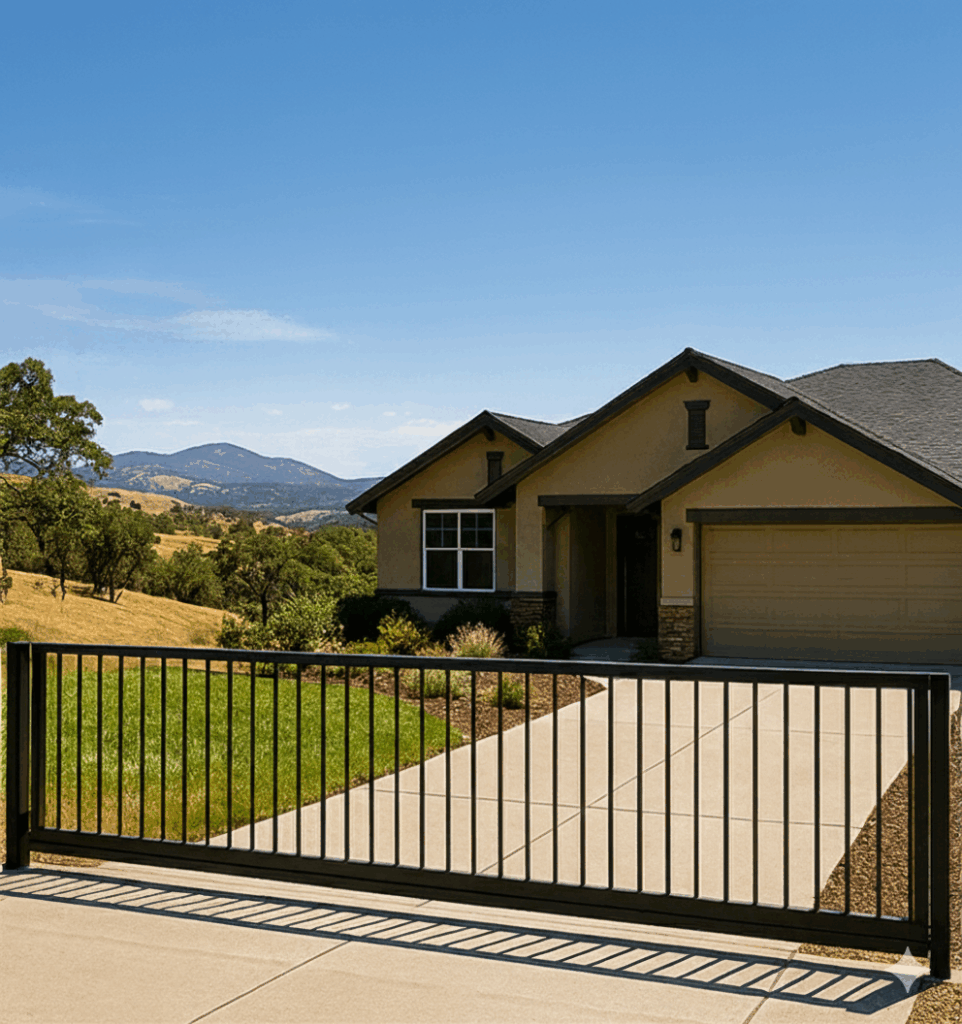
The short version: Slide gates are the most-requested gate in Placer County — at estimate after estimate, people ask, “can we do a slide?” And when the site allows it, the answer is yes. But a slide gate needs something a swing gate doesn’t: a flat, clear run beside the driveway, slightly wider than the opening itself (a 20-foot driveway needs about 22 feet of side run), with a concrete track for the gate to ride on. On Placer County’s rolling lots, creating that run means real grading and concrete work, and the panels themselves cost more — the full cost breakdown is in our swing vs. sliding gate guide. Shallow driveways and driveways that climb from the road are where slide gates shine; lots without the side room — or with sloped runouts — are where many customers, wisely, end up with a swing gate instead. A free estimate settles it in one visit.
Why Placer County Homeowners Ask for Slide Gates
We install automated gates all over the Sacramento region, and Placer County is where slide gates get requested most. The reasons customers give us are remarkably consistent — and they’re good reasons:
- “The gate just slides out of the way.” No arc to think about, no gate swinging toward a parked car or a visitor pulled up too close, no mental math about clearance every time it opens.
- It feels simpler. The gate tucks along the fence line and disappears. Guests, deliveries, and trailers don’t interact with it at all.
- And honestly — slide gates are cool. There’s an estate quality to a long gate gliding open that a swing gate doesn’t quite match. Plenty of our Placer customers want one for exactly that reason, and there’s nothing wrong with that.
So this article isn’t going to talk you out of a slide gate. It’s going to show you what your lot needs to support one — because that’s the part of the conversation that usually happens at the estimate, and it’s better to have it now. (For the general comparison of the two types, see our guide: Swing Gate vs. Sliding Gate: Which Is Right for My Driveway?)
What a Slide Gate Needs That a Swing Gate Doesn’t: Somewhere Flat to Go
Here’s the thing the brochures skip: when a slide gate opens, the entire panel has to travel somewhere — a clear run alongside your fence line that’s actually a bit wider than the opening itself. For a 20-foot driveway, we need roughly 22 feet of usable width to the side for the gate to slide into when open. And that run has to be flat, with a concrete track for the gate to ride on. So two different things can take a slide gate off the table: a lot that’s too narrow beside the driveway, or ground beside the driveway that isn’t flat — and on Placer County’s rolling terrain, we find both on lot after lot.
This is the moment in many of our Placer estimates where the plan changes. Making a sloped runout area flat means regrading, plus the concrete run the gate slides on — real site-work money, and it scales with how much earth has to move. (We publish the actual ranges in our swing vs. sliding gate cost guide.) Some customers look at that number and decide the slide gate is worth every penny. Others — very reasonably — take the swing gate that works with the ground they already have.
Why Slide Gates Cost More Than Swing Gates (and Where the Numbers Live)
The surprise for most customers is that the operators are roughly a wash: a 15-foot opening takes one slide gate operator, or two swing operators (one per leaf) — the motor budget ends up about the same. What makes slide gates the more expensive choice is the gate and the ground: the panels cost more to fabricate, the safety hardware requirements are stricter (more on that below), and the flat concrete run has to exist or be built. We keep all the dollar figures — the full price ladder and a side-by-side cost chart — in one place: Swing Gate vs. Sliding Gate: Which Is Right for My Driveway?
About that safety line: automated slide gates have to meet ASTM safety standards for reach-through protection — the gate face needs mesh, expanded metal, or vertical pickets spaced roughly 2 inches on center so no one can reach through a moving gate. It’s also why “we already have a slide gate, just add a motor” often includes a retrofit step: we regularly bring older slide gates up to standard before automating them. It’s not optional, and companies that skip it are leaving a safety and liability problem on your property.
Wind: Why a Gate Is a Giant Sail (and What We Do About It)
Every gate is a giant sail. The difference is in what’s holding it. A slide gate’s weight rests on the ground — V-track below, guide rollers up top — so wind has very little leverage on it. A swing gate hangs from its hinges: nothing underneath it, nothing holding it against the wind but the operator arm itself.
In the open stretches of Placer County where we see higher winds, that difference is real — we’ve repaired swing gates shoved around badly enough to damage operator arms. Our standard fix when a windy site calls for a swing gate anyway: a mag lock — think of it as an electric magnet that clamps the gate leaves together when closed, so the wind pushes against the lock instead of the operator arm. One honest caveat: mag locks need grid power at the gate. On solar-only foothill sites we design around it differently — one more thing the site visit sorts out.
Where Slide Gates Win in Placer County
Shallow driveways — the #1 reason. In newer Rocklin, Lincoln, and Roseville neighborhoods, the gate often sits close to the road. With a slide gate, you pull your car off the street, stop at the gate, and nothing swings toward you — no arc to stay clear of, no guessing whether you’ve pulled up too far. When driveway depth is shallow, that’s the whole ballgame.
Driveways that climb from the road. This one surprises people. On a lot that grades uphill from the street — extremely common in Placer County — a swing gate can’t swing inward, because the panels would hit the rising ground. Its only option is to swing OUT, toward the visitor pulling up to the gate. A slide gate doesn’t care: it travels along the fence line, and the grade of the driveway never touches it.
One important check: the side run. A slide gate needs flat, usable width beside the driveway that’s a bit wider than the opening — a 20-foot driveway needs about 22 feet of side room for the gate to slide into. If your lot has it (or has the flat ground to build it on), the slide gate you wanted is very much on the table. If it doesn’t, that’s usually the deciding factor — not preference.
Fire-prone eastern Placer. A significant portion of eastern Placer County falls within California’s State Responsibility Areas for wildfire — see CAL FIRE’s Ready for Wildfire guidelines. Gate design on those properties needs to account for emergency access; we build to accommodate it and recommend confirming any specific requirements with your local fire district.
When a Swing Gate Is the Smarter Choice
Simple: if you don’t have the side area for a slide gate to travel into, a swing gate is the best solution. That’s the honest version of this whole decision — a slide gate needs somewhere to go, and a swing gate doesn’t. Same answer if the ground beside the driveway is sloped and you’d rather put the site-work money into the gate instead of into dirt and concrete. On windy sites we’ll spec the mag lock from day one. There’s no wrong choice here; there’s only what your lot supports.
The full comparison lives in our guide: Swing Gate vs. Sliding Gate: Which Is Right for My Driveway?
FAQ: Slide Gates in Placer County
How much does a slide gate cost in Placer County?
Slide gates run more than comparable swing gates — the panels cost more, ASTM safety hardware is required, and the flat concrete run has to exist or be built. We publish our full price ladder and a side-by-side cost chart in our Swing Gate vs. Sliding Gate guide. Every Placer lot is different, and estimates are free.
Why do slide gates cost more than swing gates?
Three reasons: the panel costs more to fabricate; ASTM safety standards require mesh or closely-spaced vertical pickets so nothing can reach through a moving gate; and the gate needs a flat concrete run to slide onto, which can mean grading. The operators are roughly a wash — one slide operator vs. two swing operators for the same opening. The dollar figures live in our swing vs. sliding gate cost guide.
How much room does a slide gate need beside my driveway?
A flat, clear run slightly wider than the opening itself — for a 20-foot driveway, about 22 feet of usable width to the side for the gate to slide into when open. If your lot doesn’t have that width, a swing gate is the better solution.
Can I have a slide gate on a sloped lot?
The driveway and the area the gate slides into both need to be flat. If they aren’t, regrading can create the run — a real cost worth weighing — or a swing gate may simply be the smarter fit for your ground. One exception worth knowing: if your driveway climbs uphill from the road, that actually favors a slide gate, because a swing gate can’t open inward against rising ground and would have to swing out toward arriving cars.
Do slide gates really handle wind better than swing gates?
Yes. A slide gate’s weight rides on a ground track with guide rollers on top, so gusts have little leverage. A swing gate hangs from hinges and can get shoved around in the wind — on windy Placer sites we add a mag lock to hold swing gates closed so gusts push on the lock, not the operator arm. (Mag locks require grid power, not solar.)
We already have a slide gate — can you just add a motor?
Usually, yes — and we’ll also check it against current ASTM safety standards. Many older slide gates need mesh, expanded metal, or added pickets to eliminate reach-through gaps before automation. We quote the automation and any retrofit work together; see our swing vs. sliding gate guide for operator pricing.
Which Placer County areas do you serve?
All of them — Rocklin, Roseville, Lincoln, Loomis, Penryn, Newcastle, Granite Bay, Auburn, Meadow Vista, Colfax, and the surrounding foothills, plus the wider Sacramento region.
Planning a Gate in Placer County? Start With a Free Estimate
One site visit answers the whole question: whether your lot has (or can affordably have) the flat run a slide gate needs, what the wind exposure calls for, and what the real number looks like for both options — so you can choose between a slide gate and a swing gate with the actual costs in front of you.
Call (916) 713-5276 or request a free estimate online. Licensed (CA #979657), bonded, and insured — installing automated gates across Placer County and the greater Sacramento region since 2012.